


ToeJam & Earl III: Mission to Earth and Its Prototypes — When Funk Came to Dreamcast and Xbox
ToeJam & Earl, a completely crazy cocktail of adventure and action, invaded the shelves of Mega Drive/Genesis stores in 1991. Its quirky, offbeat style compared to the games of the time earned it excellent reviews in the specialized press. Giving this game a sequel nine years later seemed bold. And yet, ToeJam & Earl—old acquaintances of early-1990s SEGA maniacs—were preparing to make the leap from 2D to 3D on Dreamcast, joined by a new recruit named Latisha. The console seemed like the perfect one to revive the franchise after such a long period of inactivity… except that ToeJam & Earl III: Mission to Earth, the new 3D entry in the series, was ultimately released on Xbox!
Greg Johnson: « As for being worried about the transition to 3D. Not worried but just excited and confused a bit at first. There was a lot to figure out and test. But we had one of the best animators around, Iwei Huang. Maida Kreis built our 3D terrain, and several other artists. We had a great Art Team. And our early prototypes were exciting to see. »
The story of Mission to Earth is merely a pretext for a crazy musical delirium. ToeJam, Earl, and their friend Latisha are entrusted with an important mission by the Funkapotamus. After the theft of his sacred Funk album collection, he sensed a disturbance in the Funk — the emergence of a dark side of this African-American rhythmic music. The three companions immediately travel to Earth in search of the sage’s 12 vinyl records in order to restore the balance of Funk. They also intend to preach the good word and convert Earthlings to Funk, ‘funkifying’ them by forcefully making them listen to wild, funky riffs.
Greg Johnson: « I do remember that in the year 2000 the big push we had for 3D and it was exciting to see the characters all come to life like that. Especially with I-wei animating them. I was especially excited about the opening movie scene that I-wei animated. The one where Toejam shouts at the door "C'mon Latisha! We gotta go and save the Universe again! " »
A beautiful Xbox cover
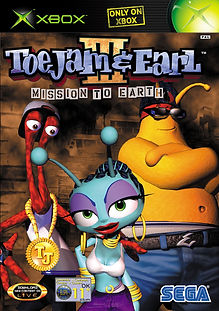
ToeJam & Earl III is similar to a typical platformer in which you must collect a certain number of keys or objects before finding an elevator to access the next level. In each map (grasslands, urban zone, desert, ice world, etc.), the player picks up various gadgets useful for progressing through the game: spring boots to reach high platforms, a pair of wings to cross huge ravines, bombs to ‘funkify’ the inhabitants of the blue planet, musical notes to hit enemies from a distance…
ToeJam and Earl, an inseparable duo. It was impossible for SEGA maniacs to escape their wild (mis)adventures in 3D!
A Development Guided by Music
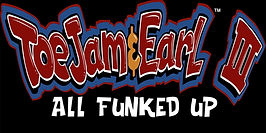
Visual Concepts, in collaboration with ToeJam & Earl Productions, planned to revisit the Mega Drive classic ToeJam & Earl created by Greg Johnson and Mark Voorsanger. They met Scott Patterson and his partner Greg Thomas, two of the three founders of VC, and then signed with SEGA to revive the series with a third 3D episode on Dreamcast. The production of ToeJam & Earl III: Mission to Earth, initially titled ToeJam & Earl III: All Funked Up, could finally begin.
The first logo and game title
I-Wei Huang: « We shared the building with them (VC), they were on the top floor and we were below them in a beautiful building on top of a hill in Marin County. I just remember Visual Concepts guys drove a lot of very nice sports cars :). Once in a while there would be limousines because some famous sports Stars would be there to get motion captured. They had a MoCap room there with a lot of cameras. »
For several months, the ToeJam & Earl Productions team, formerly known as Johnson Voorsanger Productions, developed TJ&E III for the Dreamcast. However, due to SEGA’s withdrawal from the console manufacturing market, they redirected its development to the Xbox in 2001. Following this overhaul, the programmers almost entirely rewrote the game’s code, while the artists reused the existing art assets (textures, animations, models, or rigs) by simply converting them. The developers took the opportunity to modernize the gameplay and enhance the graphics by studying several of the most visually impressive Xbox titles in order to determine what was possible with Microsoft’s new console technology—things that had not previously been achievable on the Dreamcast.
Probably to promote a canceled DLC

I-Wei Huang: « I also remember when we switched from Dreamcast to the first Xbox, we had these big dev stations for Dreamcast, that we no longer needed. And we had put them in one of the closets. So it was floor to ceiling of kit of devlopment Katana. Wish we had cellphones that took good pictures back then, would have been a good picture of that. »
The change of target platform to Microsoft’s first console, a year and a half before the release of ToeJam & Earl III, proved to be the most convenient solution from a technical standpoint and the easiest way to port the game elsewhere. In retrospect, this strategy may not have been the wisest, since the Xbox’s target audience (teen/mature), at least at the time, did not necessarily identify with this type of game. GameCube players would probably have welcomed it more warmly.
Greg Johnson: « The biggest difference between the Dreamcast and the Xbox version was the online multiplayer from the DC version. We lost that when moving from the Dreamcast. There were other things but honestly I can’t remember now. »
The development of ToeJam & Earl III: Mission to Earth lasted a total of around two years. During its production, Scott Patterson represented SEGA for the entire project. He would occasionally visit Greg Johnson and his colleagues to follow the game’s progress.
I-Wei Huang: « Usually, game development tries to stay within smaller budgets, so development cycles are often around two years, but can sometimes run longer. This is not advantageous for developers, since royalties only come after development costs are paid. Therefore, if possible, it is better to stay within budget and have a shorter development cycle. »
Concept Art of Latisha and Big Earl


With ToeJam & Earl III, the ToeJam & Earl Productions team aimed to stay faithful to the format of the original Genesis game. However, SEGA expressed reservations about this approach. The Japanese company viewed it as too ‘old school’ and requested an update by adopting a style more inspired by platformers like Donkey Kong 64. In a difficult balancing act, the developers had to find the right harmony between the expectations of the manufacturer/publisher and preserving the charm and essence of ToeJam & Earl on Mega Drive. They also toned down the game’s humorous and irreverent tone, which was considered hard to market to a mainstream audience, leading to compromises in its storytelling and dialogues.
Artwork becomes painting

I-Wei Huang: « It was a fun time, a lot of experiments we did together to make things look good. In a small company like that it was easy and quick to try and make changes. I remember painting and making the sky and clouds, and trying different things with other artists and programmers, and it was exciting when things worked. »
SEGA, which throughout its long history was rarely compelled to do so—a company respected for its risk-taking and boldness—censored an aspect of TJ&E III. Originally, the final boss, The Anti-Funk, wore a Ku Klux Klan robe until this controversial model was changed into a generic floating skull. This infamous symbol of a white supremacist terrorist secret society in the United States was unacceptable and would undoubtedly have sparked outrage among players and organizations fighting against racism and discrimination!
The productions of ToeJam & Earl Productions mainly attracted a female audience. This market research led the studio to conceptualize Latisha as a turquoise-skinned extraterrestrial, the new addition in TJ&E III. Her charm undoubtedly stole the spotlight from the heroes of the Mega Drive installments. Moreover, the dynamic interaction between three characters—creating coherent gameplay possibilities rich in emotion and storytelling—offered a dimension beyond what could be achieved with only two individuals. For example, ToeJam and Latisha constantly tease each other, although the former is madly in love with her. She also sees Big Earl as an older brother and shows him deep respect. The addition of Latisha thus brought greater depth to the game’s story and enriched its universe while leaving a lasting impression on the player.
A memorable voice-over heard in ToeJam & Earl III: Mission to Earth belongs to Genevieve Goings. She began her singing career by voicing most of the game’s female characters, including the one who narrates the story of ToeJam & Earl in gospel style. Sherrie Jackson, for her part, portrayed Latisha. Nothing seemed to predestine Genevieve for a musical career after this successful first attempt as a vocal performer, as she previously worked in the customer service department of an insurance company. Her vocal tone did not leave Greg Johnson indifferent, who collaborated with her once again to record the children’s album Choo Choo Soul, which he also composed. This is how she became the star of the Disney show Choo Choo Soul!
The Gospel of Genevieve Goings
Greg Johnson: « I asked her to try singing the lines for the Gospel Singers instead of speaking them. She belted out this incredible gospel that floored me. I then stayed after hours a few nights and had fun writing all of the gospel music parts and couldn’t wait to hear her sing them. And we are close friends to this day. »
In partnership with Microsoft, SEGA finally released TJ&E III on October 22, 2002, in the United States, followed by February 7, 2003, in Europe. Additionally, ToeJam & Earl III: Mission to Earth offered extra characters and levels accessible as downloadable content via the Xbox Live service. The quirky title from ToeJam & Earl Productions became a pioneer among Xbox games in introducing DLC. It must be admitted that this concept was both new and little known in the early 2000s.
Love at first sight between ToeJam and a cheerleader (from concept to in-game appearance)


Unfortunately, ToeJam & Earl III on Xbox received a mixed reception. Fans appreciated the return of the heroes and the funky universe of the earlier Mega Drive episodes in 3D. Critics praised its graphics and musical atmosphere but highlighted its lack of originality compared to its predecessors. Commercially, Mission to Earth did not achieve the expected success, leading to the closure of ToeJam & Earl Productions in June 2003 and a long hiatus for the franchise until the release of ToeJam & Earl: Back in the Groove in 2019.
Greg Johnson : « Last thing I will say is the whole team was excited about the Dreamcast. It was an easy system to build for. Very powerful and seemed to have a lot of potential. We were disappointed to have to move off it. »
With these final words retracing the creation of the series’ third installment, ToeJam, Earl, and the enchanting Latisha wish you an enjoyable exploration of the Dreamcast version!
The July 2nd, 2001 prototype and the Katana development kit containing it.
In 2013, against all expectations, ZakhooiTM, a member of the Assembler forum, made available to the community a prototype of ToeJam & Earl III: Mission to Earth on Dreamcast (July 2, 2001 Prototype). Dreamcast fans finally got to discover a version of the ToeJam & Earl Productions game running on their favorite console.
ZakhooiTM: « As I'm quite paranoid about that stuff. I shifted gears and contacted Greg Johnson for approval. Let say As long there was no money being made off the release he wouldnt sue me. »
This preliminary build of TJE III for Dreamcast differs from its final 2002 release on Xbox. In terms of structure and gameplay mechanics, it is closer to the early Mega Drive installments of Greg Johnson and Mark Voorsanger’s cult classic, but this time in 3D: there are no bosses, portals, keys, mini-games, or Hub World. Cinematics are also missing, one of the highlights of ToeJam & Earl III on Microsoft’s console. Around 24 levels are playable, promising an enjoyable gaming experience despite being an unfinished and buggy project.
The prototype’s startup screen

ZakhooiTM: « As I didnt play ToeJam and Earl since the Mega Drive days, I took to AssemblerGames with some screenshots so others could help identify the game. Soon after it became clear that I had an Unreleased Beta / Alpha version. »
ToeJam written straight like an ‘I’

The prototype came from a Katana Development Kit purchased on eBay. Its hard drive contained the files for ToeJam & Earl III: Mission to Earth on Dreamcast, which needed to be placed in the correct locations to function. ZakhooiTM, who initially provided the TJE III DC ISO in CD-I format (a compressed game image for burning onto a CD-R) in the early 2010s, now offers us—thanks to the preservation efforts and with the help of BANANABREAK (thanks to both of them)—the project in its original form as found on the Dev Kit. Even better, a raw copy with no modifications from the associated hard drive!
ZakhooiTM: « Well fun thing is that when I got the dev kit and got the last project running on the GD Emulator I was not greeted by a title screen so had no idea what game it was. »
After 12 years of waiting, Funk finally made its way to the Dreamcast planet to funk the Dreamcast maniacs, just as it should have in 2001 if…
TJE III as seen on the Dev Kit

You can download the hard drive image from the Katana Development Kit containing ToeJam & Earl III: Mission to Earth for Dreamcast below:
If you simply want to play ToeJam & Earl III: Mission to Earth on Dreamcast, you can download its prototype in GD-I format below:
ToeJam & Earl III: Mission to Earth (Jul 2, 2001 Dreamcast Prototype) GD-I
If you want to play ToeJam & Earl III: Mission to Earth on Dreamcast and burn it to a blank disc, you can download its prototype in CD-I format below:
ToeJam & Earl III: Mission to Earth (Jul 2, 2001 Dreamcast Prototype) CD-I
This article is dedicated to ToeJam & Earl III: Mission to Earth on Dreamcast, its prototype, and the development kit containing it. It serves as a supplement to the article focused on the work of Visual Concepts, covering the making-of of their iconic titles, with exclusive testimonies that put them into perspective, as well as the Dreamcast prototypes of: Floigan Bros.: Episode 1 - NFL 2K1 - NCAA College Football 2K2 - NBA 2K - NBA 2K1 - NBA 2K2 - Fantasy Prototype (Proof of Concept) - NHL 2K - NHL 2K2 - World Series Baseball 2K2 - Over The Top Soccer (Unreleased) - ToeJam & Earl III Mission to Earth (Unreleased) - Ooga Booga. Discover the entire preservation project dedicated to this talented SEGA-affiliated studio on following page: [The Rise of Visual Concepts in the SEGA Era: Prototypes and Behind the Scenes of the Making of Their Dreamcast Classics]
I would like to thank Greg Johnson, I-Wei Huang, and Suruchi Krieglstein for their availability, kindness, and for taking the time to answer my questions. Their testimonies allow us to contextualize the development of ToeJam & Earl III: Mission to Earth and to glimpse behind the scenes of the game’s transition from 2D, the Mega Drive episodes, to 3D on Dreamcast and Xbox.
Special thanks to:
-
Hicks for proofreading and correcting the French text
-
Tom Waterhouse for the English translation of the article
-
ZakhooiTM and BANANABREAK for providing the Dev Kit hard drive image containing ToeJam & Earl III: Mission to Earth for Dreamcast
-
Megavolt85 for the new Dev Kit check and for creating the TJE III prototype in GD-I
Similar prototypes (Unreleased): Agartha (DC) - Emulateur officiel Megadrive (DC) - Castlevania Resurrection (DC) - Half Life (DC) - Dalforce XOP (DC) - Flinstone (DC) - 4 x 4 Evolution PAL (DC) - Ring : L'Anneau des Nibelungen (DC) - Ecco 2 (DC) - Kyskrew (DC) - Propeller Arena (DC) - Geist Force (DC) - Scud Race Tech Demo Dreamcast - Shenmue 2 US (DC) - The Red Star (XBOX) - Heaven's Drive ( version japonaise de Burnout 1) pour PS2 - Jekyll and Hyde (DC) - The Grinch Jap (DC) - Worms Pinball (DC) - Quake 3 Arena version japonaise (DC) - Vectorman (PS2) - Fear Effect Inferno (PS2) - Over The Top Soccer (DC) - Fantasy Prototype (DC) - ToeJam & Earl III (DC)
Other Dreamcast Development Kits (Katana) available for download: Eurocom Dev Kit - Appaloosa Dev Kit - No Cliché Dev Kit - Tower of Babel Dev Kit - Artificial Mind & Movement Dev Kit - Sting Entertainment/FromSoftware Dev Kit - NEC Interchannel Dev Kit - Rage Software Dev Kit - Mad Catz Dev Kit - ToeJam & Earl Productions Dev Kit
Feel free to try out [The Dreamcast Unreleased Games to Download] that I found. For the more curious among you, I also wrote [The List of Cancelled Dreamcast Games], which references all of them along with information about each title.
