


Memories of Ooga Booga on Dreamcast: Fun, more fun, always fun—nothing but fun
Ooga Booga (OB) on Dreamcast follows in the footsteps of ChuChu Rocket. It is a pleasant, no-frills action/strategy game, primarily focused on online multiplayer or split-screen play. The major differences between Visual Concepts’ title and Sonic Team’s lie in the fact that OB is played in 3D and features a healthy dose of humor, but above all a strong sense of exoticism.
The challenge for Visual Concepts (the studio behind the project) and for SEGA was to take advantage of the console’s online capabilities via its built-in 56k modem (or 33k in Europe), while offering epic network battles for up to four players with minimal lag. This represented a technical challenge that very few games managed to overcome at the dawn of the second millennium.
Andrew Leker (Original Idea): « The technical architecture came from a peer-to-peer online multiplayer game I had previously pioneered, called Silencer, for Strategic Simulations, Inc. (out of Sunnyvale CA). It was a revolution. We were able to get a smooth 24 FPS game running on 400ms modem latency for up to 8 players. It used a novel idea of hiding latency in animation, so the user would see their own character pulling their gun out and firing, but the opponents would see the player snap their gun out and fire. It was NOT interpolation. We actually ran the game ahead 10 frames into the future and displayed what we knew would happen, based upon how long a user’s input was held before actually being used. »
An eye-catching cover
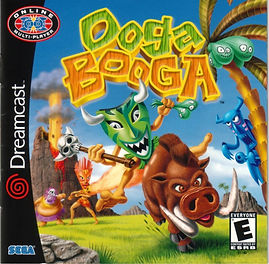
The action of Ooga Booga takes place on a tropical island that rises from the depths of the sea with each full moon. In this multiplayer adventure, the player takes on the role of one of the four Kahuna wizards available from the start, each belonging to different tribes with their own strengths and weaknesses: the Twitchy, the Hottie, the Fattie, and the Hoodoo. As the game progresses, the player unlocks new voodoo spellcasters such as Death, President Abraham Lincoln, or a Leprechaun, to name just a few.
To win the favor of the volcanic deity Ooga Booga—and thereby avoid a needless civil war while ensuring peace on a land where magic reigns supreme—an ‘Olympic-style’ competition was established, leading to a series of increasingly extravagant challenges: Capture the Flag, Tiki War, King of the Hill, and the Scavenger Hunt, among others.
Consequently, four natives endowed with mystical powers engage in long, intense battles, using fireballs, tornadoes, lightning, and mines to their advantage. Without a shadow of a doubt, the Tiki Dance proves to be the most powerful weapon, unleashing earthquakes, showers of stones, and a multitude of other catastrophes. Players can also ride a warthog to chase down opponents or attack them from the air while flying on the back of a bird.
Hmm, which wizard to pick…

Unfortunately, the release of Ooga Booga on Dreamcast in the United States on September 13, 2001, went largely unnoticed due to the lack of a supporting marketing campaign. The announcement earlier that year that Dreamcast production would cease did little to help the game’s sales. On top of that, the World Trade Center attacks, occurring just days before its release, sealed the fate of OB’s hopes longevity. Now sidelined in an unfavorable environment for commercial success, SEGA decided not to localize it for the European and Japanese markets. Nevertheless, critics praised its smooth gameplay, immediate accessibility, and zany atmosphere. Players who gave it a chance regarded it as a little gem of multiplayer madness, perfect for fun-filled evenings with friends or online!
Michael Biancalana (Artists): « Soon after we shipped, SEGA sadly decided to veer away from its free online service and instead charge $30 a month - which was the same price as our entire game. This was the deathblow to Dreamcast and especially our game which was so reliant on multiplayer. If it weren't for that, I'm sure a lot more people would have enjoyed our game. It was quite fun after all. »
Like Floigan Bros and ToeJam & Earl III, Ooga Booga on Dreamcast reflects Visual Concepts’ ambition to diversify its game offerings beyond sports simulations!
A development sprinkled with the supernatural
Ooga Booga on Dreamcast originated from the ‘Resurrection’ project, a title developed for an independent video game competition in the late 1990s. The concept of the initial prototype—a real-time strategy game—was based on turn-based board game rules, in which the player controls strategic points on a map. Following an impressive demonstration of ‘Resurrection’ that captivated the audience, it won the Best Game Design award of the year at the inaugural Independent Games Festival during the 1999 Game Developers Conference.
A rare shot of Resurrection

Resurrection, a game to be unearthed

Andrew Leker: « I loved working on Ooga Booga. It started originally as Resurrection, which was a very different game. It was more strategy. However, our first attempt to adapt it to become a Dreamcast game involved heroes moving across the playfield. They could attack each other, but their main ability was to raise land and create fortifications. The higher the fortification, the greater the range. The goal was to take over the playfield. »
Impressed, Visual Concepts took the initiative and hired its creator, Andrew Leker. Regarded as a specialist and pioneer in online game design, he would supervise their Netmare online multiplayer system, used in the NFL 2K and NBA 2K titles on Dreamcast. Contract clauses also granted him complete freedom to explore the concept of his ‘Resurrection’ project within the California studio and to expand the development of his RTS during work hours. Gradually, the project evolved into a fully independent game, now known by the code name ‘Djinn’. Eventually, Andrew assembled a small team to work on what would become Ooga Booga on Dreamcast.
Michael Biancalana: « I met Andrew Leker around 1998 (through a newspaper ad, believe it or not). He was putting together a video game concept for an upcoming indie contest. He favored people he had worked with before and had the right attitude for building something from scratch, which is how I got my first official game job. Our team of five was pretty new to game dev. We did a lot of learning how to do our jobs as we were doing them. »
Unfortunately, Resurrection (Djinn) did not adapt well to SEGA’s hardware. It was never originally designed in the style of a Dreamcast game, nor developed with the console’s capabilities in mind. The game required action to take place on dynamic (deformable) terrain, which the Dreamcast struggled to compute for technical reasons, making it difficult to render properly on screen. Implementing a two-player mode on the Dreamcast became even more complicated. Faced with this initial hurdle, the development team felt lost and unsure of which direction to take.
Andrew Leker: « I remember having an idea one evening. I came to work the next day and pitched Ooga Booga - the idea of four shipwrecked people controlling voodoo islanders. Shrunken skulls for coconuts and magic battles to put on a good fight. The ideas needed simplification, but that was the inspiration for what became Ooga Booga. »
Shortly after OB went into development, creative differences arose between its creator and the management at Visual Concepts. Andrew Leker then left VC to continue his career independently. The development team he had assembled—mostly people with little industry experience—suddenly found themselves without a leader to guide them in a studio primarily focused on sports simulations. At that point, Michael Biancalana and his colleagues’ work on Ooga Booga could have ended. However, thanks to the determination of Greg Thomas, one of Visual Concepts’ co-founders, to pursue innovative initiatives within the company, OB avoided a premature demise.
Reimagined Visual Concepts logo
Michael Biancalana: « Floigan Brothers had already been in development for some time and had accumulated a sizable team, plus there was the incubation of the "Toejam & Earl" team, so there weren't a lot of resources or attention to commit to our project. We were allowed a good deal of freedom as a result, and rather than just continue to develop the same game concept without Leker to guide us, we collectively did some brainstorming to figure out how we could revitalize the project and make it our own. »
Due to this rocky start in Ooga Booga’s production, the developers studied a variety of multiplayer games to conceptualize their own and get a fresh start. Super Smash Bros caught their attention and would influence the further development of OB. This Nintendo 64 classic guided their thinking in creating a fun and chaotic multiplayer experience, infused with a tribal and magical touch. Artistically, they drew inspiration from illustrator Josh Agle, aka Shag, and his Tiki paintings. Once their choices were made, the game artists began sketching levels featuring spellcasters on deserted islands. The development team broke away from traditional action game conventions by opting for caricatured characters and a deliberately absurd tone.
Let the games of the circus begin

Michael Biancalana: « We'd play together to Super Smash Bros pretty regularly to inspire us and bond as a group. »
Riding this positive momentum, Ooga Booga on Dreamcast gradually took shape, with an initial prototype that was already very fun to play in its embryonic form. The team and their new creation gained popularity within Visual Concepts, even attracting the interest of Scott Paterson, the company’s Vice President, who had remained hands-off during production until then. Energized by the support of other VC employees, the team conducted numerous tests to refine and perfect their ‘baby’, aiming to deliver an optimal gameplay experience.
Michael Biancalana: « Leandro Peñaloza joined us along the way as our Art Director and helped us pull everything together. The whole development went pretty smoothly. It was about a year and a half from concept to ship with only seven developers (+2 audio devs on loan). We didn't have any major drama or power struggles. »
Visual Concept's expectations of OB remained modest, however. The pressures were minimal, though not entirely absent. The designers of Ooga Booga still faced difficulties integrating single-player elements into a game originally designed for multiplayer as development neared its end. John Race (Producer) managed to create a single-player campaign in record time, while Evan Harsha (Engineer) implemented the artificial intelligence at the last minute
Michael Biancalana: « Throughout the lifespan of "Ooga Booga", I learned that passion and collaboration can get you a lot further than you think! Being on a tight-knit Team with common goals and no egos was a lot of fun and highly productive. Still one of my fondest Game Development experiences to date. »
The development of Ooga Booga ended almost simultaneously with that of Floigan Bros on Dreamcast. For this reason, VC decided to merge the two teams into a single unit of fifty people. The role of this newly formed team would be to prototype non-sports games in the future. It would develop appealing, unfinished titles such as Escape from New York (Unreleased), Crazy Taxi (really?), Mad Max (Unreleased)…
Michael Biancalana: « We didn't get very far on Escape from New York. Scott Patterson was coordinating the effort to acquire these licenses and a number of them fell through (which is how that process goes). For Mad Max we built a short teaser-trailer, Marc LeBlanc wrote an entire physics engine from scratch for driving a car across open world terrain. Soon after that, EA snagged the rights when they found out we were in negotiations. I did some research about creating materials for XBox to support an open world Crazy Taxi game, but that project also didn't get the green light. We thought another SEGA team was going to take it, but apparently not. »
Appearances can be deceiving

In the absence of a Dreamcast prototype of Ooga Booga to showcase, the preservation project centered on Visual Concept still deserved a making-of and special attention to the game's history!
This article explores the history of Ooga Booga on the Dreamcast. It serves as a supplement to the article focused on the work of Visual Concepts, covering the making-of of their iconic titles, with exclusive testimonies that put them into perspective, as well as the Dreamcast prototypes of: Floigan Bros.: Episode 1 - NFL 2K1 - NCAA College Football 2K2 - NBA 2K - NBA 2K1 - NBA 2K2 - Fantasy Prototype (Proof of Concept) - NHL 2K - NHL 2K2 - World Series Baseball 2K2 - Over The Top Soccer (Unreleased) - ToeJam & Earl III Mission to Earth (Unreleased) - Ooga Booga. Discover the entire preservation project dedicated to this talented SEGA-affiliated studio on following page: [The Rise of Visual Concepts in the SEGA Era: Prototypes and Behind the Scenes of the Making of Their Dreamcast Classics]
I would like to thank Michael Biancalana and Andrew Leker for their availability, kindness, and for taking the time to answer my questions. Their testimony allows us to better understand the origins of Ooga Booga and the story of its development.
Special thanks to:
-
Sadako Playerone.tv for proof-reading the French text
-
woofmute for the English correction of the article
Continue your reading by exploring the other articles featured on the following page: [Articles, Databases, Making-ofs, Interviews, Special Discoveries, and Photo or Development Archives]
