


Castlevania: Resurrection (Dreamcast) – Inside a Legendary Lost Prototype
A commercially unloved machine elevated to the status of legend, the Dreamcast, like any other console, still holds its share of mysteries. As we know, multiple prototypes lie dormant around the world, some taking more than twenty years to come to light. Much like games such as Scud Race or other long-awaited but never released titles, Castlevania Resurrection remained a chimera for a long time, and fans of the franchise even wondered if it truly existed. Well, not only does it exist, but it goes far beyond a simple tech demo that lets you move a character in an empty world without any interaction.
Before we dive into the details of this Demo, shown behind closed doors (exclusively to journalists and VIPs) at E3, let’s take a moment to uncover the story of this elusive title—a game that never saw the light of day in stores.

Castlevannia Resurrection Prototype Trailer

A Fallen Promise
The first information about Castlevania Resurrection began appearing in magazines during the summer of 1999. It was indeed at that time, in their summer double issues, that the gaming press extensively covered the titles showcased at the grand event of the video game world: E3. Back then, all journalists agreed in praising the game’s spectacular graphics. Konami was clearly determined to take full advantage of the Dreamcast’s capabilities, promising stunning lighting effects as well as a faithful adherence to the Castlevania license, particularly in terms of atmosphere. Looking at the screenshots in our magazines, one thing was clear: Resurrection delivered undeniable visual punch! Detailed textures, high-quality lighting, varied creatures—the Konami title was genuinely enticing.
And yet… some media outlets didn’t hesitate to express reservations. Indeed, Castlevania Resurrection was the work of a relatively inexperienced American team, and the words of producer Ken Ogasawara, reported in Joypad No. 88, were not exactly reassuring:
« Since the Castlevania N64 sold exceptionally well in the United States, it was clear that the title remained a safe bet in this country. All of the game’s development is being handled in the U.S. by an American team. We aim to release the game for Christmas 1999 in the United States. The Dreamcast version will be primarily action-oriented, as our goal is to create a true gamers’ game. »

Make no mistake: it wasn’t because the title was being developed by a U.S. team that players and the press began to voice concerns. Rather, Castlevania had long been a franchise built around action, adventure, and exploration. Inevitably, the more “brute-force” tone of such statements didn’t sit well—especially with longtime fans of the series. Clearly, many feared that the license might lose its identity…


Another point worth noting—and one that shows just how cautious we should be with such statements—is the announced release date: Christmas 1999, only a few months after Ken Ogasawara’s interview. To put this into perspective, one need only look at the exceptional Skies of Arcadia, which was still in a completely embryonic state when it was first announced. Worse still, seven months before its Japanese release in October 2000, the game world (during airship flight sequences) was entirely empty!
What this comparison illustrates is that, in the summer of 1999, Castlevania Resurrection was likely little more than the core of what it was meant to become. And all it takes is a glance at Joypad No. 92 from December 1999—coinciding with the release window envisioned by the producer—to learn that Resurrection was only… 25% complete.
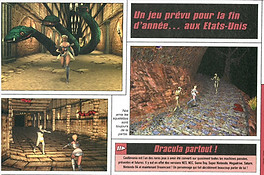
Despite an initial wave of enthusiasm, the title would ultimately vanish into limbo in almost total indifference—or nearly so. Cancelled during the spring of 2000, it would take another 21 years for the existence of a rare version shown at E3 1999 to finally come to light: a surprising prototype that we have tested and examined from every angle.
A Fortunate Duo

The game’s story takes place in 1666. Players take on the role of Sonia Belmont, the first member of the Belmont clan—a woman born with a supernatural gift that allows her to sense the presence of spirits. Her grandfather taught her how to wield the whip, having sensed that this ability would one day lead his granddaughter into great danger. Within the Castlevania timeline, Sonia is also the heroine of Castlevania Legends, a Game Boy title released in 1997.
Castlevania Resurrection therefore places players in the role of Sonia, and unsurprisingly, her weapon of choice—the whip—makes a return. Originally, she was meant to be accompanied (meaning the player could control a second character) by a certain Victor Belmont, a descendant of the Belmont clan. This seemingly introduced a time-travel element, with the adventure involving switching between the two protagonists, possibly across different eras.
On paper, it really looked good.
A Promising Prototype: The Levels
Castlevania Resurrection, in its prototype state, shows interesting qualities despite the unfinished implementation of multiple elements.
When the prototype is launched on a standard Dreamcast, here is what happens: the Konami logo and the Castlevania Resurrection title screen flash by at high speed (likely to save time during journalist demo sessions at E3 1999, and the game immediately jumps to the so-called ‘Courtyard’ level. The player then takes control of Sonia.
The 'Courtyard' Level
To start, you move into a small recess on the right and face a first wizard as well as a sort of evil totem that shoots fireballs. This little isolated area feels like a sort of tutorial, even though the difficulty isn’t balanced at all. You’re also surprised by the continual respawn of spirits that swarm the main character. Clearly, action was the main focus for the team at this stage of development. You’re literally assaulted by these specters! To get out of the mess, you decide to head left. After a fight with a wizard, you climb a low wall and reach a more open area.
'Courtyard' Gameplay Showcase
Here, you can begin exploring the surroundings and attack the various wizards in the section, as well as skeletons who don’t hesitate to throw bones from their perches. Using the D-pad, it’s possible to switch to an auto-seek camera, which is a relief since the default focus isn’t optimal. In manual mode, pressing the Y button recenters the camera..
The atmosphere of Castlevania is definitely present, at least in terms of intent, and you can even have fun interacting with the flames (turning them blue probably had some effect on opening the cathedral door you can see). After a brief rooftop sequence, we’re back on solid ground.
The bestiary isn’t particularly varied, and there are, of course, bugs, but the approach is interesting. Regarding inventory and items, they aren’t fully implemented yet, but it’s amusing to see that hitting a candle, just like in the originals, produces a heart to restore health. Once this level is cleared, you can move on to the next one. To do this, simply press START to access the DEBUG menu. You can then choose another stage

The 'Chapel' Level
The level titled ‘Chapel’ takes us into the heart of a religious building. The atmosphere is much stronger than in the previous level, with its lava, flames, stained glass windows, and large arches. Once again, the ever-present specters stick close at your heels! Yet there’s a certain pleasure in wandering through this area while defeating wizards.
'Chapel' Gameplay Showcase
You can have fun hitting objects to collect all kinds of items (vials, compass…) and even a secondary weapon (a throwing knife you launch with the B button, an axe, an explosive vial, or even a protective book that spins around the avatar). Upstairs, a few enemies await you as well (and skeletons block your path).
The atmosphere of this level is very engaging and hints at some of the possibilities the game could have offered players if it had ever been released. Frustrating, of course… especially since a boss fight is hidden here: MEDUSA.
The Boss: This was probably meant to be a small challenge for journalists at the time. By hitting the flames in the area, a door opens and you gain access to this mythological creature. The boss has two transformations, and the fight takes place in a fairly large room, allowing for easier movement.

The 'Stairs' Level
The ‘Stairs’ level is much larger, and it’s possible that a boss fight was intended for this area. You move through a wide zone before climbing a large staircase on the right. For the occasion, the bestiary is enriched with new wizards who throw blue fireballs. You can pick up axes as a secondary weapon and even a sort of shield. Amusingly, by pressing the L + R shoulder buttons simultaneously along with the analog stick, Sonia Belmont performs a roll… but remains stationary. This feature wasn’t implemented in this ’99 demo. The level is just a preview, and there isn’t much to do except enjoy beating up a few enemies.
Stairs' Gameplay Showcase
The 'Stairs' Level
The ‘Hall’ level starts outdoors and then continues into a room where you face wizards. This was likely meant to be an area with a boss or at least a mini-boss. After defeating these foes, a door opens, and if you touch the other door – which was supposed to lead to the next level – the game crashes.
Indeed, the last playable level in this version is called ‘Corridor’, and it isn’t accessible on the original hardware. You have to use an emulator to access it. On Demul, the level isn’t available, but we tried Flycast, and it worked.
'Corridor' Gameplay Showcase
The 'Corridor' Level
‘Corridor’ is a chase sequence featuring the Lernaean Hydra, that three-headed mythological serpent. The camera is completely off, but you can still make out the developers’ intentions, and it’s easy to imagine that, if properly tuned and finalized, this sequence could have been very enjoyable.
Conclusion
Castlevania Resurrection, in its E3 ’99 prototype form, features four stages (with a fifth accessible via emulator). Considering that the game, according to rumors, never progressed beyond 25% development, it’s possible that another version exists—but if it does, it likely isn’t much further along. The vision was there, and while the execution isn’t spectacular for a Dreamcast title, there are still some nice effects and certain backgrounds really stand out.
The Prototype: Analysis
The music, composed by Mark Lindsey (Original Music Copyright ©1998), consists of a single looping track. You can explore his other compositions on his website. Feel free to credit him in your video descriptions by including both links and the copyright—it will make him very happy.

This prototype version is not yet optimized, so it may experience slowdowns or freezes. Some bugs are also present, such as the ability to pass through the environment.
The enemy lock-on system has not been implemented yet, making it hard to tell if you’re hitting your target, which can be frustrating at first. Over time, however, you get used to it.
When using the Start Menu to select a level, you begin the new environment with your previous health bar and equipment. The same applies after dying: you regain your secondary weapon.
Secondary weapons don’t appear to drop randomly. They seem to be distributed based on the number of times the level is loaded (to be confirmed). You may need to replay "Chapel" four times to obtain the protective grimoire.
Upon arriving in front of “Medusa”, the game freezes, likely due to a cutscene not included in the beta version. After defeating the boss, an emblem appears. When it is collected, the demo restarts from the Konami logo, this time with the player indicators (health bar) visible, just like in the rest of the game. It will no longer be possible to face the Gorgon afterward.
The more new levels are loaded, the more powerful our whip becomes.
Using a controller plugged into port B, pressing Start activates Free Camera mode. Hold Y to move up, A to move forward, X to move backward, B to move down, and use the directional pad to rotate the camera. The left trigger increases movement speed.

The whip and sub-weapons (items) have a charged attack. Holding X or B fills the blue bar to release it. Charging a sub-weapon causes the equipped item to be lost, deals more damage, and executes a unique move.
The #20 marked on the disc indicates that it is the 20th GD-R produced for this compilation/version of build. At least 19 other copies were created beforehand. At this point, it is likely that these 19 discs have been lost or destroyed.
Inside the build files
The “INTRO BIN”, just like “COMMON” or “E70_MEDUSA” are texture archives.

No additional Debug modes are present aside from those previously mentioned, and there are no hidden levels.
The “Corridore” level crashes on a real Dreamcast because the code tries to access invalid memory areas, outside the allowed ranges, which causes the system to crash. This issue is not easy to fix. On some emulators, however, the level works because they simply ignore these memory accesses.
Download Links (Homemade Cover and Unofficial Guide)


If you want to dress up your game, you can download and print (at full size) a PAL cover provided by Sapass Krem :
If you want to dress up your game, you can print a Japanese cover (click on the image and then print) provided by Gregg Super on this site:
placeholder


Capt. Gravestone created a collector's guide for Castlevania Resurrection compiling all of his research. You can download the PDF file and print it.
Prototype Download Link (ISO)
The download pack includes (please read the "README"):
-
GDI_ORIGINAL: Original GD-R dump in Raw format (BBA method)
-
GDI_ODES: 33 MB miniaturized GDI to use with GDEMU, USB-GDROM, MODE, or emulators. Creation and addition of a 0GDTEX.PVR image for the menus
-
CRDC-CDR.CDI: CDI image to burn on a 700 MB / 80 min CD-R. Data padded outside the disc for better performance. Burn with DiscJuggler or ImgBurn using the DJ plugin
-
CRDC-NOPAD.CDI: Small 113 MB CDI image to use with GDEMU, USB-GDROM, MODE, or emulators. No padding added. Try burning this version if your DC has trouble loading the version above from a CD-R.
You can download this Castlevania Resurrection Dreamcast prototype below (a pack containing multiple ISOs, depending on your preferences).
Castlevania: Resurrection E3-Pre-Demo ISO Pack (Nov 5, 1999 prototype)
You can read a document on the game's reverse engineering by visiting the page: [Castlevania Resurrection DC Reverse] .
I would like to thank the following people:
-
All the people (dev, composer ect) involved in this project that never saw the light of day
-
The owner of the prototype for trusting me with the GDI
-
Régis Monterrin for writing the article
-
Darcagn for modifying the game to run from a CD on a standard Dreamcast
-
Sapass Krem for creating the cover
Similar prototypes (Unreleased): Agartha (DC) - Emulateur officiel Megadrive (DC) - Castlevania Resurrection (DC) - Half Life (DC) - Dalforce XOP (DC) - Flinstone (DC) - 4 x 4 Evolution PAL (DC) - Ring : L'Anneau des Nibelungen (DC) - Ecco 2 (DC) - Kyskrew (DC) - Propeller Arena (DC) - Geist Force (DC) - Scud Race Tech Demo Dreamcast - Shenmue 2 US (DC) - The Red Star (XBOX) - Heaven's Drive ( version japonaise de Burnout 1) pour PS2 - Jekyll and Hyde (DC) - The Grinch Jap (DC) - Worms Pinball (DC) - Quake 3 Arena version japonaise (DC) - Vectorman (PS2) - Fear Effect Inferno (PS2) - Over The Top Soccer (DC) - Fantasy Prototype (DC) - ToeJam & Earl III (DC)
Feel free to try out [The Dreamcast Unreleased Games to Download] that I found. For the more curious among you, I also wrote [The List of Cancelled Dreamcast Games], which references all of them along with information about each title.
