


The origin and chronology of the NFL 2K license games on Dreamcast, accompanied by prototypes
At the end of the 1990s, American football games were going in circles. While productions such as Madden NFL, NFL Blitz, NFL Quarterback Club, NFL Fever, and NFL GameDay were still keeping players on the edge of their seats, gamers were nevertheless craving something new. They hoped to one day be able to play the perfect NFL simulation, little knowing that SEGA would soon be granting their wishes!
The first game in the 2K series

The Japanese manufacturer, ever vigilant, noticed the expectations of American football fans. In anticipation of the launch of the Dreamcast in the United States, SEGA planned to offer them the NFL game of their dreams. SOA tasked its latest acquisition, Visual Concepts, with designing it. Originally named NFL 2000, the game would ultimately be called NFL 2K and was the first title in the company's new line of sports games, the famous 2K series.
Michael Rhinehart (Associate Product Manager NFL 2K2): « So from a technical standpoint, I think Visual Concepts pushed the hardware as far as anyone, which SEGA applauded but also expected as they were the owners of VC at the time. »
SEGA was going to make every effort to ensure the game's commercial success, starting by providing attractive packaging that would appeal to the target audience. Visual Concepts collaborated with Randy Moss, former Minnesota Vikings player and American football icon, recognized as the second-best touchdown receiver in NFL history, to design the cover for NFL 2k Dreamcast. Just like NBA 2K featuring Allen Iverson of the Philadelphia 76ers, the blue hedgehog company and its young protégé VC knew how to surround themselves with the right people to make a lasting impression!
Michael Rhinehart: « It was an important deal each year. It actually got to a point that the athletes really wanted to do this. But in the earlier days, it could be very tricky. »
It was unthinkable for SEGA to miss the September 9, 1999 deadline. In this tense context, the final stage of NFL 2K's development proved to be challenging for the Visual Concepts team. Management allocated all of the California studio's resources to finalizing NFL 2K and then NBA 2K within the allotted time frame. VC's other parallel projects were put on hold, notably at the expense of Floigan Bros Dreamcast. While some staff members hoped to take a break after the timely delivery of NFL 2K, they were immediately reassigned to NBA 2K, which was then entering its intensive crunch period ahead of a planned release date of November 10, 1999!
Nick Jones (Engineers NFL 2K/1/2 and NCAA 2k2): « The crunch on NFL2K was mind boggling. We would stay working in the office to at least 4am, sometimes as late as 6 or 7am. I'd drive home, catch a little sleep, then drive right back into the office. On my way home I'd sometimes grab a MacDonalds breakfast ( pancakes and maple syrup ) and it got to the point that my young son expected it EVERY MORNING. He was really upset when we finished the game and I stopped working so late ( and bringing breakfasts home for him ). »
Souvenir item from Peter Moore for the US launch of the Dreamcast

The Dreamcast was released in North America on September 9, 1999, and crowds flocked to stores, some of which opened at midnight to satisfy eager customers. Launch day was accompanied by a rich and varied catalog. The impact of NFL 2K and NBA 2K, the latter of which was released a few weeks after the console, significantly boosted overall sales. It was a masterstroke by SEGA, which set a record at the time with more than 225,000 consoles sold in 24 hours!
Nick Jones: « I remember one time I was walking past the Conference Room and the TV was on and a real NFL game was playing on it. I paused for a bit to see who was playing and only then did I realize it was actually the game. Just for a few seconds, it fooled me. So I stood there watching it for about 5 minutes. When I turned around to go, I realized that there was a whole bunch of other people behind me who had all done the same thing. Thats.... when I knew the game was going to be really successful. »
Praised by critics, NFL 2K immediately established itself and became a key selling point for the Dreamcast. With the possible exception of Soul Calibur, no other game better illustrated the technological gap created by the console. Never before had National Football League players been so beautiful, so realistic in their animations, or moved on the field with such class, determination, and detail in an American football game.
American football, a contact sport

Nick Jones: « The boss had lots of discs burnt and was running the game on may different Dreamcasts. He was playing AI vs AI and comparing the results with real world teams. He wanted the Artificial Intelligence to reflect the real NFL as much as possible. »
The developers at Visual Concepts took full advantage of the Dreamcast's processing power. This technical feat was evident from the very first few minutes on screen. VC experimented and regularly tried new things. They even continued to add features to NFL 2K right up until its release date, well beyond the Alpha version deadline that was supposed to lock in the game's rules and mechanics.
Nick Jones: « The team would often go out around 2am to a local cafe that was open 24 hours a day. Or the boss would go to the local 24 hour supermarket and buy a ton of cookies and donuts for us all to eat. »
Due to time constraints, the VMU Play Calling option did not deliver the anticipated result. The memory card does not reproduce the planned play scheme as on a training board, but simply lists the strategies to be adopted, without the aesthetics initially envisaged. This option would remain unchanged for future expansions.
Nick Jones: « The Dreamcast controller had a black and white display that was 32 pixels by 24 pixels if I remember correctly. I tried really hard to get the full screen plays drawn on that display but it was just far too low res and I couldn't get them working and looking ok. If I'd had more time, I probably could have. »
The wild years of video game ads

For its part, Electronic Arts monitored NFL 2K Dreamcast closely. The player base for its Madden NFL games was shrinking. For the first time, the American publisher was facing a formidable opponent. While the console manufacturer and EA had already had disagreements following the failure of talks to develop for Dreamcast, competition between them intensified, much to the delight of gamers. Which company, EA or SEGA, would offer the next most successful American football simulation? The confrontation between these two video game titans promised to be memorable!
Nick Jones: « We always beat Madden in terms of gameplay and looks. I think it was because VC was more driven by the Development Team and Electronic Arts' Madden was mostly driven by the Marketing Team. They were always afraid of trying to develop their game whereas Visual Concepts wasn't. »
There was no question of SEGA slowing down. During E3 2000, the company behind Sonic unveiled NFL 2K1, the promised sequel to NFL 2K. This new edition of Visual Concepts flagship title looked set to be a beauty and finally showcased the Dreamcast's online functionality, which had been used sparingly until then. It was the showcase of choice, with which SEGA affirmed its determination to produce first-rate sports games and bring online gaming to its latest creation, the Dreamcast.
A gaming kiosk at E3 2000

Michael Rhinehart: « Then came E3 where I had to help do Network setup for the show. This was a nightmare because no one took into account Network issues with all the electronics running at LA Convention Center. I was up all night until 7:30 am before show open. Had to go to my hotel room, shower and then stand at the kiosks demoing the full day. This was considered a huge treat as a tester at SEGA to be able to do this directly with a developer. »
Visual Concepts finally launched NFL 2K1 on September 7, 2000, five months after its remarkable appearance at the Electronic Entertainment Expo. As with its predecessor, the sports commentators' commentary was so high quality that it feels like you're watching a real American football game. NFL 2K1 impressed on all fronts with notable improvements in graphics, gameplay, and animations. Featuring all the teams and players from the National Football League, NFL 2K1 further enhanced the ability to relive the sport in as realistic a way as possible in a video game. The addition of online multiplayer mode completed the gaming experience!
Nick Jones: « Setting up online play was a nightmare. We had no experience setting up servers. And we were dealing with modems too. »
SEGA's decision to incorporate a modem into its 128-bit console changed the gaming landscape forever. It paved the way for a new way of playing console video games: online. This was a trend that all video game companies followed. Although industry professionals applauded the Dreamcast's online features when SEGA unveiled its specifications in 1998, they encountered many difficulties in implementing online multiplayer for the games concerned and establishing protocols for testing them. In fact, with the emergence of online video games such as NFL 2K1, many didn't know how to proceed and had to learn on the job!
Michael Rhinehart: « Greg Thomas called me up at SEGA asked if I could come up for a week to test Network on NFL 2K1 in preparation for his demonstration at E3. He had heard about my test plans that I set up for ChuChu Rocket. I had to teach everyone what I thought were the variabities we needed to test for. He said it is going to be a tough week, but he would put me up in a hotel and get a car service for me. I told Greg I lived less than 10 minutes from Visual Concepts and it wouldn't be necessary. 100+ hours in 5 days. »
Touchdownnnnnnnnnn

Developed at the same time as Quake 3 Arena Dreamcast, NFL 2K1 and NBA 2K1 did not benefit from the Ethernet adapter code programmed for Q3A or from the expertise acquired in network gaming by Raster Productions and, in particular, by Sega of America Dreamcast, a subsidiary of SOA. The page [Quake 3 Arena Dreamcast and its eight prototypes: when a Western FPS almost came out in Japan] goes into detail about the development of its online mode through several testimonials. Visual Concepts took charge of the integration of the online mode from A to Z; a turbulent project.
Michael Rhinehart: « I made people play from ISPs all over North America to simulate what we'd see in gameplay situations. ISPs (Internet Service Provider) barely existed in some places. I think we even figured out how to get AOL (America Online) to work with the Deamcast. »
In the United States, NFL 2K1 outsold Madden NFL 2001 PlayStation 2 when it was released. It sold 139,000 units in its first seven days on the market (compared to 126,000 for Madden NFL) and reached a total of 208,000 copies sold by the end of its second week (compared to 159,000 for its competitor). This exceptional performance caused concern among EA executives, who were quick to respond with a sneaky counterattack!
Nick Jones: « EA were really afraid of us. Afraid enough that they got sole rights to the NFL so we couldn't make it anymore. And they got sole rights the Teams and the Players too. And we were branded ESPN Football so EA signed a deal with ESPN to take that from us too. »
Well on its way to becoming a long-running series, NFL 2K2, the third installment, was released on September 19 on Dreamcast, November 20 on PlayStation 2, and January 9, 2002, on Xbox. The sudden demise of Dreamcast repositioned the NFL 2K series as Madden NFL's main multiplatform rival. Well received by the public and the specialist press, it highlighted the evolution of AI, the fluidity of passing play, and the addition of new player animations. On the downside, Franchise mode remained unchanged from 2K1. The game even included the Houston Texans with fictional players, as the team would not be founded until 2002 and did not yet have a real roster.
Michael Biancala (Artists for Ooga Booga): « At Visual Concepts, we all did some work on sports titles on occasion. They were using very early MoCap and motion matching back then which was exciting at the time. »
American football players are brutes

August 28, 2001 saw the release of a surprising new American football game byn Visual Concepts. This game, entitled NCAA College Football 2K2: Road to the Rose Bowl, focused on college football, unlike its predecessors in the National Football League series. It was the last exclusive football game released by VC on Dreamcast.
For six years, the Californian studio developed four titles under its original NFL 2K label (NFL 2K/1/2/3), followed by two installments renamed ESPN NFL Football and ESPN NFL 2K5. Due to EA's exclusive rights with the NFL, intended to eliminate all additional competition, Visual Concepts ceased producing video games under the NFL license in 2005. However, VC did not forget its iconic series that had served it so well, and actually dared to circumvent the agreements between Electronic Arts and the National Football League by releasing All-Pro Football 2K8 in 2007!
Nick Jones: « So VC signed a deal with all of the retired players and we made our own football game called NFL Legends if I remember correctly. CEO of EA had an utter fit when he realized what we had done and so went out and signed exclusive contracts with all of the retired NFL players so we couldn't use that either. So that was us done with making any form of NFL. »
25 years after its release, gamers fondly remember the launch of NFL 2K on Dreamcast and secretly hope that Visual Concepts will return to the forefront with this franchise that shook up the industry!
The NFL 2K1 prototype from June 21, 2000
Analysis of the prototype reveals that this build of NFL 2K1 Dreamcast was burned on June 21, 2000, at 20:06:04. It predates the final US version, released on August 31, 2000, by approximately two months. At this stage of Visual Concepts game development, several elements appear rough on screen, notably the atypical visual rendering of the stadiums. Those who explore this beta will notice strong similarities with the first installment of the series and will think they are playing NFL 2K0.5 rather than NFL 2K1!
NFL 2K1 Dreamcast Prototype trailer
A standard Dreamcast console fitted with Disc System 2 (the GD-ROM disc that can run prototype builds on hardware) cannot boot a physical prototype disc such as the NBA 2K1 GD-R dated July 26, 2000. These discs can only be launched on a Katana Development Kit. To read the beta ISO in an emulator (DEmul will not work), Flycast requires that you first load a more recent revision of the same game. For example, you can launch the retail/final version, then return to the emulator interface and load the GDI dated June 21, 2000.
The size of 1ST_READ (the executable) is 7,939,192 bytes, compared to the usual 3,309,092. Other peculiarities are probably hidden in the bowels of the prototype.
The title with Randy Moss (E3)
When the prototype starts up, the “SEGA SPORT” logo appears on a white background, rather than the expected black background, and remains completely static. The title screen then appears instantly, without any transition, showing live-action footage of American football players from the early 21st century.
While waiting to choose the exact music that would accompany the NFL 2K1 Menus, the developers opted for another song as a placeholder.
The loading screens surprise with their unfinished appearance.

The title screen uses the “image” from the E3 version of NFL 2K1, as specified in the copyright notice: “(©) SEGA Enterprises, Ltd., 2000 E3 Version”. The shades in the background photo are less dark and tend toward purple for Randy Moss's jersey, which will take on a blue tint when the game goes GOLD. There are also other differences, such as the blue “Press Start Button” display, which will change to “Press Start” in white. In addition, this Splash Screen does not include the logo and copyright for MPEG Sofdec (a video container format designed by CRI Middleware).
A distinctive look

The Menus offer surprising game settings options that would be removed during the later stages of NFL 2K1's development, such as “Network Play” or ‘Framerate’ in “GAME OPTIONS”. Sometimes configuration options that are supposed to be there are missing!
The font used for certain information in a Menu appears to be temporary, particularly for details that will be removed in the final version (team names in yellow, Menu names, etc.).
In this build, no sports commentator announces the players' entrance onto the field until the kickoff of the match.
Uncommon in sports games
The football pitch lacks consistency with the final game, with a uniform green color that lacks the texture of grass blades!

The rough appearance of the character on the right side of the screen in the first team creation window (“TEAM CREATE”) inevitably catches the eye. In this context, rough shapes and fleeting blue and white textures define the athlete's appearance. We also note this subtle bluish and whitish tint appearing on the feet, sleeves, or hands of certain elite athletes participating in a match, especially with historic teams.
During the process of creating the ideal football player, temporary pink textures are applied to the chin guard, black strips under the eyes, mouthpiece, and breathing strip. Some shoes have an unfinished silhouette.
Stadiums in NFL 2K1 are likely based on the stadium design of NFL 2K, reusing their graphics. This would eventually include more detailed textures, better lighting, and potentially more dynamic elements such as the audience. At the time of burning this GD-R of Visual Concepts title, the development team was working hard on its graphical overhaul. White blocks with basic outlines replace the stands and crowds in sports stadia in this intermediate version of NFL 2K1. This simplistic rendering, rarely seen to date in a sports simulation beta, makes it remarkable!
This is just the beginning of the review of this amazing NFL 2k1 prototype. The rest is coming soon, right now in fact!
Based on the first NFL 2K game
NFL 2K1 Dreamcast can be considered an improvement on NFL 2K, enhancing its components and incorporating never-before-seen content. The developers designed the sequel based on the architecture of NFL 2K. The prototype contains elements from the first game in the series, such as the SFD format intro sequence. NFL 2K0.5 uses the Menus from NFL 2K, although a partial visual transformation and reorganization of the options within them can be observed. For example, the “TEAM SELECT” and “TOURNAMENT TREE” Menus from NFL 2K have been reused and slightly redesigned.
Curiously, the Menu layout is similar to that of NBA 2K1, suggesting that Visual Concepts was considering harmonizing the Menus of NBA 2K1 and NFL 2K1 before reverting to the models used in NFL 2K and NBA 2K.
The prototype shows NFL 2K graphics on the Dreamcast memory card screen and does not yet use the pixel image from NFL 2K1. This also applies in-game on the DC controller's VMU in the “CONTROLLER” Menu.
The virtual keyboard is ordinary and does not feature the distinctive design that was ultimately implemented for NFL 2K1. However, it is the same as the one used in NFL 2K. As long as it works, the rest is of little importance!
Not yet upgraded in NFL 2K1

In the final game, to unlock the cheats in NFL 2K1 Dreamcast the player must go to “OPTIONS”, select “WEATHER”, and then simultaneously press the “Left on the D-Pad”, “Right on the Analog Stick” and the “A” button. This brings up a ‘CODES’ option in the “OPTIONS” Menu. Like its big brother NFL 2K, the prototype automatically reveals this normally hidden Menu without the need for manual intervention to unlock it.
The NFL 2K VMU screen

This beta version of NFL 2K1 Dreamcast features all the stadiums already available in the first installment and so doesn't take into account the changes that occurred in real life American football during the year 2000. On March 26, 2000, the city of Seattle demolished The Kingdome Stadium. To stay true to reality, the developers replaced it with Husky Stadium in NFL 2K1. This scenario was repeated, this time in advance, for Cinergy Field, which was demolished on December 29, 2002, and replaced in the game by Paul Brown Stadium, which opened on August 19, 2000. Washington Stadium, in anticipation of the release of the expansion pack, would be renamed FedEx Field, while Cleveland Stadium would be renamed Browns Stadium. Other minor differences (such as abbreviations) can be seen in the names of other stadiums, such as “Metrodome” instead of “H.H.H. Metrodome”...
In light of the analysis of the prototype carried out so far, its nickname NFL 2K0.5 seems quite appropriate, doesn't it?
Additional content in NFL 2k1
NFL 2K1 Dreamcast was not just a simple technical upgrade of NFL 2K, but went beyond that by adding new features. It introduced a “Franchise” mode, online matches, and the ability to play with historic players/teams from the National Football League. At the stage of NFL 2K1 development when the developers were working on this prototype, these additions are basically presented in a new light. Visual Concepts implemented them and constantly tried to improve their usability through numerous iterations, including the one in this build.
The choice to play with iconic teams from NFL history is made directly in the “TEAM SELECT” Menu by changing “2001” to “Historic”. Usually, a Sub-Menu specific to this game setting appears when clicking on the “Visitor Options” or “Home Option” options.
The selection of historical players


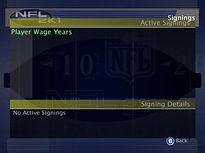
In this form, the “Franchise” mode is unrecognizable. Some Sub-Menus are missing, such as “FRANCHISE MANAGEMENT”. Sometimes, options that are usually found in Sub-Menus appear directly in the game mode's Main Menu, such as “Signing” and “Trade”, which would normally appear in “FRANCHISE MANAGEMENT”. The ‘Stats’ option does not work; it does not redirect the player to the “SEASON STATS” Sub-Menu. On the prototype, “Games” corresponds to “Schedule/Play” in the final version. The following photos show other aspects of Franchise mode in addition to those listed above (left: prototype, right: final version):
Franchise Setup


Signings

Franchise Main Menu


Games or Schedule/Play


There are many configuration options missing for starting an online game in NFL 2K0.5. The ones recommended in this build seem more suited to settings for playing using a VC or SEGA local area network (LAN).
The “Franchise” mode deserves closer examination, rather than just a cursory glance as previously given. Its operation remains strange...
.jpg)
You can download this build of NFL 2K1 Dreamcast below
Other prototypes of games in the NFL 2K Dreamcast series and NCAA College Football 2K2
No thorough research has been conducted on the prototypes listed below. They are available for direct download.
.jpg)
.jpg)
.jpg)
.jpg)
.jpg)
Important: The E3 build freezes. This appears to be a bug, an emulation issue, or a bad burn, as the prototype scan shows no extraction errors. The physical disc does not work on a Katana Development Kit or a standard Dreamcast.
This article focuses on the beta versions of the NFL 2K and NCAA College Football 2K2 series. It serves as a supplement to the article focused on the work of Visual Concepts, covering the making-of of their iconic titles, with exclusive testimonies that put them into perspective, as well as the Dreamcast prototypes of: Floigan Bros.: Episode 1 - NFL 2K1 - NCAA College Football 2K2 - NBA 2K - NBA 2K1 - NBA 2K2 - Fantasy Prototype (Proof of Concept) - NHL 2K - NHL 2K2 - World Series Baseball 2K2 - Over The Top Soccer (Unreleased) - ToeJam & Earl III Mission to Earth (Unreleased) - Ooga Booga. Discover the entire preservation project dedicated to this talented SEGA-affiliated studio on following page: [The Rise of Visual Concepts in the SEGA Era: Prototypes and Behind the Scenes of the Making of Their Dreamcast Classics]
I would like to thank Nick Jones, Michael Biancala, and Michael Rhinehart for their availability, kindness, and for taking the time to answer my questions. Their testimonials allow us to go back in time to the development of Visual Concepts' first 2K game and get a glimpse of the rivalry between SEGA and EA for the video game rights to the National Football League.
Special thanks to:
-
Antoine MERIGNAC for proofreading and correcting the French text
-
Neil Riddaway for the English correction of the article
-
Megavolt85 and LemonHaze for their research on the NFL 2K1 prototype analyzed in detail on this page
Really special prototypes (big differences, early Builds, weird ones, etc.): Guilty Gear X (DC) - Dead or Alive 2 (DC) - Samba De Amigo (DC) - Virtual-On Oratorio Tangram (DC) - Spirit of Speed 1937 (DC) - Re-Volt (DC) - Phantasy Star Online (DC) - San Francisco Rush 2049 (DC) - Evil Twin: Cyprien's Chronicles (DC) - Toy Racer (DC) - Space Channel 5 (DC) - Sega Smash Pack Vol.1 (DC) - Red Dog (DC) - Propeller Arena (DC) - Half-Life (DC) - Jet Set Radio (DC) - Daytona USA 2001 (DC) - Floigan Bros. Episode 1 (DC) - NBA 2K1 (DC) - NFL 2K1 (DC) - NHL 2K (DC) - World Serie Baseball 2K2 (DC)
More than 300 prototypes have been digitized. You will find them available for free download in the section: [Dreamcast prototypes (and more) available for download]
