


Geist Force Dreamcast and Its Prototypes: At the Heart of the Milky Way
SEGA, transformed for the duration of a game into a space agency, embarked on a delicate mission to explore alien worlds by launching the Geist Force (GF) probe toward the Dreamcast Galaxy.
It all began during a conference at E3 1998, when SEGA announced it was joining the space race. The captivated audience could hardly believe their ears. Five months later, with preparations finally complete, a rocket successfully lifted off from the TGS spaceport to send GF exploring deep space.
A small step for man, a giant leap for the Dreamcast

Unfortunately, not everything went according to plan. GF was lost beyond the Dreamcast release-schedule belt, near Pluto. Although its guidance system has been out of order for over 25 years, the probe still communicates sporadically with the retrogaming world, occasionally providing binary data in the form of prototypes. This article is the latest message transmitted by Geist Force!
Hsin-Chien Huang (Art Director), Sonny Santa Maria (3D Animator), and Christian Senn (Art Production Manager), who were involved in the GF project, attended its launch from the Space Operations Command and Control Center located at SEGA Product Development (SPD). They look back on its creation.
SEGA, we have a problem. Beep.beep.beep.beep.biiiiiiiiiiiiiiiiiiiiiiiiiiiiiiiiiiiiiiiiiiiiiiiip
The Development of Geist Force Dreamcast: A Space Odyssey
Geist Force Dreamcast symbolized SEGA's desire to balance game production between the Japanese and Western branches of the console manufacturer. SEGA Product Development (SPD), an in-house studio of SEGA of America largely unknown to the public, was responsible for its design. About 15 members made up the core development team.
Sonny Santa Maria (3D Animator): « Geist Force was my very first game dev experience. There were so many things special about it. The Team, the Studio, the Project. It was just a magical experience for me. Even though the project didn’t see the light of day., a lot of its creative members ended up working on some of the Big Games in the industry. »
SEGA has always strived to establish itself in the American market, which gradually became their primary market, notably thanks to the unexpectedly strong sales of the Mega Drive/Genesis. SEGA of America was created to compete with Nintendo in the United States and establish a presence on the continent. To meet the growing demand for games tailored to Western players, various studios overseen by SOA were opened, including SEGA Technical Institute (Sonic 1-3, S&K, Sonic Spinball, Comix Zone, The Ooze), the most distinguished of them all. Following the cancellation of Sonic Xtreme for Saturn, developed by STI, SEGA of America restructured these studios into a single entity called SEGA of America Product Development (SOAPD). SEGA Product Development, with its game Geist Force during the Dreamcast era, represents the logical continuation of SEGA’s efforts since 1986, the year SOA was established.
A render of a Geist Force-Wing

Christian Senn (Art Production Manager): « Sonic Xtreme had a fantastic engine but no real game yet. Geist Force had portions of a game without a real engine. »
The development of Geist Force began in 1997. SEGA aimed to showcase the Dreamcast’s technical capabilities in 3D graphics and visual effects with this science-fiction game. Regularly in the spotlight, GF unquestionably embodied the brand’s revival alongside its spiral-console. Initially planned as a Dreamcast launch title, it was repeatedly delayed before fading from view and ultimately being canceled.
The creatures populating the galaxy

Christian Senn: « The Art Team functioned well and we had most of the planned Artwork completed by the time the game was canceled. The design crew did a good job of defining our goals, and programming did a good job of implementation, but somewhere between those 2 roads there were issues. In short, there was a lot to do, and a lot of moving targets. The delays that occurred ultimately led to a clash with SEGA’s business plans for release. »
The reverse-engineering operation carried out on the prototype examined on this page confirms that Geist Force’s artistic direction and sound design had been fully realized. The build contains “all” of the game’s textures, animations, and music/sound effects, although most of this data goes unused during gameplay. At the time of its cancellation, the developers were likely in the process of bringing it to life by assembling everything.
Christian Senn: « Regardless of the challenges and outcome of Geist Force, it was a pleasure to work with the team and I am thankful for the opportunity. We had a lot of good times during development ranging from meal outings together, to field trips to Monterey Bay Aquarium, to breaks playing the Virtua Fighter 3 arcade machine in the kitchen. Even the every-day was typically enjoyable with a healthy amount of humor and hard work. »
A visual of Frog Pond
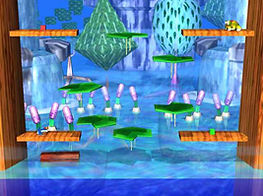
Alongside the development of Geist Force, four SOAPD employees—Jason Kuo (Design), Dave Sanner (Programming), Aoki Kunitake (BG Art), and Christian Senn (Characters/Music)—worked for a few months on Frog Pond for the Dreamcast, an Unreleased title forgotten by the public. After its cancellation, some of them joined the GF team. This small online multiplayer game never entered production. It remained at the pitch stage, although a first prototype was programmed and some graphical elements were created (character models/animations resembling frogs, environmental art exploration, concept designs, one music track, etc.). SEGA considered Geist Force a higher priority and commercially more viable.
Christian Senn: « Essentially it was a PvP game of frogs that could navigate frog pond-themed environments. Last frog standing. :-) »
Despite its ambitions, the project faced complications. The SEGA Product Development team struggled to master the new technologies offered by the Dreamcast. In 1997/1998, the tools and hardware available to developers were constantly evolving. Just as they were getting familiar with one version, the next would already be released. It’s important to remember that at that time, the technical specifications of SEGA’s 128-bit console were not yet finalized—they would only be set a few weeks before its launch in Japan. The engine also suffered from instability and poor performance, which significantly impacted the design of Geist Force, influencing what could realistically be implemented during pre-production.
Sonny Santa Maria: « I didn’t even get to know the engine we were using. It was a different time in the Industry. Back then, most Artists just dealt with the asset creation and handed over the completed data to either the Technical Artists or Engineers/Programmer. Unlike today, we’re more involved in engine-work. Creating Animation, Graphism, Asset and other scripting in engines such as Unreal. The only thing I clearly remembered was we were using a proprietary engine. One thing I fondly remember was our workstations. We were using SGI (Silicon Graphics). They were like the Muscle Cars of that time. »
A variety of in-game environments

A worthy successor to Panzer Dragoon, Geist Force Dreamcast helped inspire a sense of optimism at SEGA when the blue-hedgehog company announced it at E3 1998 and again five months later at the TGS. The version shown at the Electronic Entertainment Expo differed drastically from the one displayed at the Tokyo Game Show. The California show’s trailer depicted a game using less than 30% of the Dreamcast’s power, with pre-rendered graphics. The president of SEGA of America claimed at a press conference that the game ran in real time—a misleading omission, as the video shown at the Japanese event proved otherwise. It reflected the true visuals of Geist Force, as later confirmed years afterward when one of its prototypes was unearthed.
Opening title screen of Geist Force

A boss fight arena

Tokyo Game Show presentation video
The GF demonstrations sparked public enthusiasm. Industry professionals praised its execution, while journalists and players marveled at the special effects of this shoot ’em up, which set a new standard. Nothing generated as much excitement for SEGA’s upcoming console as these early previews of Geist Force Dreamcast. The game began its promotion with great fanfare—until it gradually faded from the spotlight…
Sonny Santa Maria: « As anticipated, the Demo was well received by the public and raised a positive boost for the soon-to-be launched Dreamcast. »
SEGA initially targeted a mid-1999 release window for Geist Force DC. As delays piled up, the company’s business strategists revised their plan, ultimately aiming for a December 10, 1999 launch—just in time to proudly sit under the Christmas trees of thousands of families. With development in a precarious state, it became clear that the schedule could no longer be met. The SPD team unanimously said no when Bernie Stolar asked if a holiday launch was still feasible. Some time later, SEGA of America management decided against it and canceled the project. Programmers, aware of potential layoffs, resigned, while the others were fired. Despite everything, the studio itself did not close.
Christian Senn: « If I had to speculate how much longer the team needed to complete a finished game, I’d say 1 more year for a quality product. Up until the point of cancellation, the team had developed a number of systems that would support content growth, but more work was needed on this infrastructure, tools, and a large amount of content. »
Perhaps SEGA should have waited a few more months before starting the development of Geist Force Dreamcast, until the tools and hardware stopped changing so rapidly…
Geist Force Dreamcast: The Game – A Space Adventure
Drawing its inspiration from the pure style of games like Star Fox (Lylat Wars on N64 in Europe), the tension of the Alien Saga, and the graphic style of Japanese Manga, Geist Force’s action takes place in a distant future threatened by an alien invasion.
Sonny Santa Maria: « Obviously, Star Fox was one of the inspirations. A lot of the artists were fans of Space Opera stuff. I know the main hero/pilot took inspiration from the facial features of Brandon Lee (The Crow). I remember a lot of the members were playing Mario Kart back then too (not sure if it was for inspiration or simply for entertainment). »
The storyline follows the adventures of a human arriving on an alien planet. During the exploration, he befriends an indigenous alien species. Suddenly, a strange hostile creature appears on the horizon. Danger lurks. This creature has the power to transform all machines into monsters. The mysterious man, aided by his newfound allies, joins forces with the alien to hunt it across the game’s six levels and finally defeat it in an ultimate confrontation.
Geist For Dreamcast Prototype Trailer
The gameplay is based on a subgenre of the Shoot ’em up: the Rail Shooter. In this 3D shooting game, the player takes on the role of a human army pilot tasked with protecting the galaxy. At the helm of a spacecraft, they face waves of enemy ships, taking part in thrilling battles across diverse environments. Piloting a ship along a mountainside, flying over an erupting volcano, weaving through narrow desert canyons, skimming the ocean at supersonic speeds, or sightseeing on the ice floes—all becomes virtually possible in Geist Force Dreamcast!
Sonny Santa Maria: « Working on a launch title that involved Creatures, Aliens, Spaceships all happening in a Fantasy world, that will always be a dream-project for anyone working in this creative field. Great times for sure. »
The game also incorporates strategic elements, particularly in battles against the bosses of its six levels. Whether this feature was part of the development process or intended for the final release remains unclear, but the Geist Force Dreamcast prototype includes sections where players can move freely rather than being confined to a computer-defined path. These can be explored via the "Mike's Room" option in the Main Menu. Another major detail: a two-player mode, likely cooperative, also appears to have been planned.
The developers estimated that it would take between 5 and 6 hours to complete the game. By adding more exploration elements than the funnel-like experience Geist Force offered at the time of its cancellation, they hoped to extend its longevity. Additionally, a scoring system was intended to increase its replay value. This system appears at the end of certain levels when playing the Alpha version.
A squadron at the ready

黃心健 Hsin-Chien Huang (Art Director): « It was fun working on this game. I am very sad that it was canceled, because I think it could have been a great and fun game. »
Although popular during the 2D era, people lost interest in shoot ’em ups with the advent of 3D. As the genre was fading by the end of the second millennium, Geist Force Dreamcast would have delighted Shmup fans awaiting its revival!
The Geist Force Prototypes: An Interstellar Message
The retro gaming community and video game historians went into a frenzy in 2012 after the discovery of the first Geist Force Dreamcast prototype. Everyone could finally test it and see what it was all about. A giant leap for man, but a small step for humanity!
In the spotlight, all eyes turned to this game that had caused such a stir in the late 1990s. Although unfinished and buggy, the SPD title was finally living the life it had dreamed of before Bernie Stolar’s announcement of its cancellation. Dreamcast enthusiasts were now paying tribute to it and indirectly thanking the unsung heroes behind the project by playing it. Indeed, Geist Force Dreamcast deserves close attention!
黃心健 Hsin-Chien Huang: « All the artistic elements were done, the basic flight mechanic had been implemented, so that you could fly through all the levels. 2 maps had been made by the programming team (also with the boss of each level). The 6th was to take place in space. It involved special flight mechanics and was not completed. »
To infinity and beyond

The GF prototype documented below differs from the previous one as the only properly digitized version—that is, without modifying the game’s ISO to make it work. However, the two builds available to the public do not include Geist Force’s initial user interface, as shown at 0:57 and 2:08 in the “Initial Animation Proposal” video by 黃心健 Hsin-Chien Huang (his portfolio) or in period promotional screenshots. Research to unearth a version with its original HUD is ongoing!
Initial Animation Proposal (vidéo by 黃心健 Hsin-Chien Huang)
Technical configuration (vidéo by 黃心健 Hsin-Chien Huang)
Sonny Santa Maria: « Game development is an ever-evolving process. Throughout the duration of any game dev, a lot of things could change from the early conception all the way down to almost the final stages of production. These includes Character Design, Levels, HUD and other elements of the game all in the service of better play experience. That’s why Play-Testing is such a crucial part of development. »
Today, a symbol of a console then in constant technological evolution during its development, Geist Force Dreamcast left an undeniable mark on the industry and in the hearts of players. It exudes a unique aura, and the mysteries surrounding it continue to fuel the imagination.
The Organizational Chart of the Geist Force Mission Operations Technicians
Over the years, the list of people who worked on an Unreleased game and their roles has been lost in the annals of video game history. Since the game was never released and no credits exist for it (except in rare cases depending on the project’s progress before cancellation), the information is nowhere to be found. Unfortunately, MobyGames, the largest database of video game credits, only lists the “Acknowledgements” for commercially released titles.
Right away, sir!

黃心健 Hsin-Chien Huang: « I was the artistic director in charge of 6 artists + 1 artistic director. The studio, consisted of 4 programmers, 2 game designers, 1 producer, 8 artists. »
Today, establishing the organizational chart of a development team for an abandoned project is often nearly impossible. Below is a non-exhaustive table of the Geist Force Dreamcast team.
Christian Senn: « I worked closely with the art director, Hsin-Chien Huang, to ensure his team of artists had what it needed to do their jobs, ranging from design documentation, equipment and software, to the schedule of deliverables. »
Mark Subotnick : Producer
Yasuhara Hirokazu : Game Designer
Shin Hamanaka : Producer/Game Designer
Christian Senn : Art Production Manager
Hsin-Chien Huang : Art Director
Peter Kim : Concept Artist
Sonny Santa Maria : 3D animator
Ben Fischer : Artist
Mun Lee : Artist
Becky Chow : Artist
Nimai Malle : Lead Programmer
Ito Yuichi : Programmer
Mike Bowman : Programmer
Sonny Santa Maria: « I was brought in to do animation on Geist Force. Primarily, as a Creature Animator. It was a great opportunity to animate some of the most fascinating creatures including the Queen Boss and a few sub-bosses among other things. »
We can only feel sorry for them for not being able to fully realize their ambitions and creations.
Geist Force Mission 2: In Search of the Ninth Planet of the Solar System
Personal projects undertaken outside of office hours sometimes result in something that reaches beyond the private circle. Company leaders appreciate the individual initiatives of their employees. In the industry, some Dreamcast games were born from their creators’ aspirations pursued during their free time.
Thus, Scott Hawkins’ SEGA Swirl for PC/Dreamcast, coded in his garage, impressed Shinobu Toyoda (SOA Executive Vice President), who decided to give him a chance. This puzzle game eventually made it onto the console’s demo discs and browsers for SEGA’s 128-bit system. Another example: the development of the official Mega Drive emulator for the Dreamcast, which began as a simple programming exercise by David Harvey, reached the ears of SEGA Europe executives. Discussions were held in London to commercialize it, but the discontinuation of the Dreamcast put an end to the young developer’s ambitions.
Meanwhile, Christian Senn was secretly working on Geist Force 2 while he and his colleagues were developing the first game. Out of a love for creation, he spent countless hours imagining a coherent sequel to GF1. His proposals for a new entry in the Geist Force franchise consisted only of concepts and inspirational sketches, far from a complete plan to expand the universe of the science-fiction game.
Christian Senn: « So the chaos of being creative was not only a nice reprieve, it was also necessary for me as an artist and game designer. »
During the day, he made sure that the artists at SEGA Product Development had everything they needed to create high-quality illustrations, maintained the artistic production schedule, and assisted Hsin-Chien Huang in organizing operations. In the evening, as a creative outlet after a long day of work, he sketched the outlines of Geist Force 2.
Depending on the critical and commercial success of Geist Force Dreamcast, Christian planned to later share the ideas he had sketched and outlined for a second installment with the rest of the development team. With a better alignment of the stars, Geist Force could have become a franchise encompassing multiple sequels, prequels, or spin-offs!
A sequel to Geist Force on Dreamcast? Players would have embraced it even before the first one was released!
The April 23, 1999 Prototype of Geist Force Dreamcast: The First GD-I
Analysis of the prototype indicates that this build dates from April 23, 1999, at 12:36:11. This Alpha of Geist Force Dreamcast was burned 17 days after the version made available to the community in 2012 by members of the ASSEMblergames.com forum (April 6, 1999). It is the first GF beta offered in GD-I format without any alterations to ensure its functionality. The ISO from the previous SEGA Star Fox leak had been provided in CD-I format with modified, non-original files. During the few weeks separating the two prototypes, the game evolved, particularly in terms of Level Design and the removal of invisible barriers that had prevented full exploration of certain levels.
Sequence not used in game
Panzer Dragon Saga (codec test)
Extracting the files from the disc led to two amusing discoveries: a silent pre-rendered cutscene of Geist Force not visible during gameplay of the prototype, and a high-resolution video of Panzer Dragoon for Saturn accompanied by the music from Sonic CD, likely used by SEGA to experiment with a video codec.
The Level and Game Mode Selector
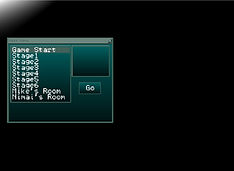
The prototype starts with a level selector (“Stage 1/2/3/4/5/6”) and a game mode selector (“Game Start”, “Mike's Room”, “Nimai's Room”). Unlike the April 6, 1999 version, it does not display the version number or the build date.
The “Game Start” mode: The player launches Geist Force in the classic way, with several Copyright Spash Screens (“PRESENTED BY SEGA”, “TRUEMOTION”) before being greeted by a beautifully lit title screen. After that, they watch the opening scene of Geist Force as a spectator, then take control of a spacecraft to face “Stage 1”, continuing through the subsequent levels.
(Apr 06, 1999 Prototype)
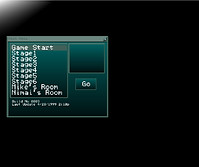
(Apr 23, 1999 Prototype)
“Stage 1”: The player starts directly on the first level of Geist Force Dreamcast, bypassing the splash screens and the GF prelude mentioned above. This level offers the most complete gameplay experience, as it is playable from start to finish—with enemies and a Level Boss to defeat. The scoring system is revealed once the level is completed, and parts of the environment are destructible. Geist Force shows itself here in its final form for an unfinished game, so to speak!
“Stage 2”: Midway through, after the interlude cutscene, the level is emptied of its enemies. However, the player can still traverse the entirety of the valleys and caverns on the map without being able to complete it. They eventually reach the Boss arena and can only imagine the fight.
“Stage 3”: The files for the third level are missing on the GD-ROM. As a result, it does not load.
“Stage 4” after the hilltop

“Stage 4”: As in the April 6, 1999 prototype, the aircraft gets stuck while ascending the snowy hill shortly after the level’s starting area, just before reaching the crest. This invisible barrier disappears in free exploration mode within the “Mike's Room” game mode.
“Stage 5”: The developers removed the long and seemingly endless level introduction present in the previous build when burning this GD-R of Geist Force Dreamcast. They also fixed a bug—an invisible barrier—that had prevented full exploration of the map, including the area for the Level Guardian, a kind of power generator. Unfortunately, it is not present. Additionally, the player encounters no obstacles throughout the level. No threat looms on the horizon!
“Stage 6”: The massive spacecraft with strange textures that appeared here just days before this Geist Force Alpha was created no longer materialize on screen. The expression “the cosmic void” perfectly describes this level. The player simply moves within a skybox—a graphical technique that creates the illusion of a vast, three-dimensional environment.
“Mike's Room” mode: This game mode removes the normally imperceptible rail that the spacecraft follows. Levels can then be explored freely, but without hordes of enemies to defeat. In its default configuration, the prototype only loads “Stage 1” in “Mike's Room”. To work around this and make all maps playable in this mode, we created an ISO image (a CD-I) for each level. You can download them below. Be sure to check out “Stage 6V2” (accessible only in “Mike's Room”), which takes place in deep space near a red dwarf and a habitable planet with a ring.
“Nimai's Room” mode: Selecting “Nimai's Room” opens a window with a black background. Inside, a green-framed box labeled “Sound Test” appears, allowing the player to configure the game’s audio.
Control scheme
This SEGA title requires some time to get the hang of before mastering it and getting a feel for its controls. There are many key combinations to memorize. Once the player has automated the movements and actions, they will take on the role of an astronautical legend behind the cockpit of their Geist Force–made X-wing. Will they be able to match—or even surpass—the Red Baron in terms of victories?
By connecting a Japanese keyboard to the console's Port B, anyone can have fun altering the game's internal state—whether to cheat or to turn their GF-Wing into a Kamikaze plane. Geist Force also includes a Debug Menu that allows testing of various development-specific features.
Controls:
-
Joystick : Pilot the ship
-
D-Pad : Select between the different attacks you have, corresponding to the shots configured on the B button
-
A : Fire lasers
-
A (Hold): Allows targeting multiple enemies simultaneously. Releasing A after locking onto targets will fire at all aimed enemies at once
-
B : Launch multiple missiles in a burst
-
X+A : Another type of multi-missile attack
-
X : Increase movement speed
-
X (Tap): Barrel roll in flight
-
Y : Slow the ship briefly
-
L or R : Tilt the ship’s wings to the left or right for a tight turn. The L maneuver does not work exactly like R (sometimes you need to press R then L for L to register)
-
L + R : Rapidly gain altitude
-
L + R + START : Pause Geist Force. Pressing this combination again resumes normal gameplay
-
Level selector tip: Disconnect and reconnect the controller twice to start the game automatically without the Debug Menu
The Debug Menu:
-
S3 : Open the Debug Menu
-
D : Access Debug options
-
U : Open user options
-
S : Pause the game
-
T : Switch to the Menu screen. After pressing a letter, use the D-Pad directions to navigate within the menu
-
F12 : Destroy the player-controlled ship (suicide)
-
F1 : Give the player’s ship 9999 shield/health points
-
Z : Rapid-fire lasers
The solar system in Geist Force (“Stage 6V2”)
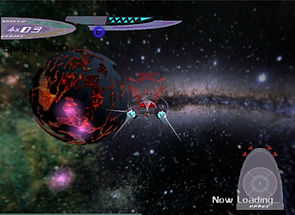
The differences, illustrated, between the two known Geist Force prototypes
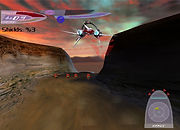
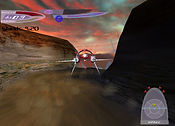
Comparing different betas of the same game is similar to playing a “spot the difference” game. This visual puzzle, which involves detecting a number of subtle errors or variations between two nearly identical images, provides insight into the graphical changes made from one prototype to another, or from a preliminary version to the final release. Here are a few examples from Geist Force on Dreamcast (April 6, 1999 prototype on the left, April 23, 1999 prototype on the right).
“Stage 2”: The enemies, represented by colored spheres, are green instead of red. They will obstruct the player’s progress on the map near the wreckage of a crashed aircraft.

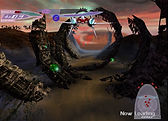
“Stage 5”: The Power-Up, the only one present in the April 6, 1999 build, was removed from Mission 5 for unknown reasons. At that time, were the Geist Force designers experimenting with an item collection system to give the player an advantage?


“Stage 6”: On April 23, 1999, Thanos snapped his fingers, and the motherships with peculiar textures vanished! He was probably preparing to carry out the Eclipse several decades later.


“Stage 2”: Just before the mid-level cutscene, the developers removed the encounter with four enemies blocking the player’s path. But why? These creatures were actually easy to defeat!
Download links to play Geist Force on Dreamcast
This is where it gets tricky, sorry. No solution has been found to combine all of the Geist Force Dreamcast ISOs in CD-I format onto a single digital medium. The method used to create a compilation including different versions of a Dreamcast game—like with Agartha DC or Jekyll & Hyde DC—does not apply to this SEGA title. Who knows why.
As a result, to fully enjoy Geist Force, you will need to download six separate game ISOs: Geist Force in GD-I format (April 23, 1999 prototype) or Geist Force Dreamcast in CD-I format (April 23, 1999) and Geist Force Dreamcast Pack (Stages 2/4/5/6/6V2)
As mentioned earlier in the chapter [The Level and Game Mode Selector], the “Mike's Room” mode automatically loads only “Stage 1 in the default prototype configuration. In order to play “Stage 2”, “Stage 4”, “Stage 5”, “Stage 6”, and “Stage 6V2”, it was necessary to create a separate ISO for each level of Geist Force.
The Flycast and DEmul emulators are unable to run Geist Force. It is recommended to use nullDC for emulation.
Some recurring issues when playing Geist Force:
-
When using an emulator, the opening scene of GF and the mid-level cutscene in “Stage 2” freeze. It is possible to skip the prelude by pressing the action button, but this trick does not work for the other problematic cutscene. Ultimately, the game crashes midway through “Stage 2”.
-
The prototype, when run via GDEMU, correctly plays the GF intro sequence, but the “Stage 2” issue persists.
-
Burning the game to a blank disc finally allows full exploration of “Stage 2”, but the opening video still freezes.
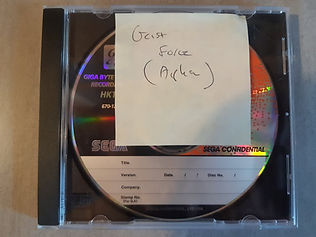
Download link for Geist Force Dreamcast (the April 23 prototype) without any content alteration in GD-I format (BBA Dump):
Download link to burn Geist Force Dreamcast (the April 23 prototype) to a blank disc (CD-R) in CD-I format:
Download link in CD-I format to play “Stage 2”, “Stage 4”, “Stage 5”, “Stage 6”, and “Stage 6V2” in the “Mike's Room” game mode (a pack of 5 ISOs):
Messages to future explorers of Geist Force Dreamcast: May the SEGA Force be with you!
The April 6, 1999 Geist Force Dreamcast Prototype
In 2012, members of the Assemblergames.org forum unearthed the first prototype of Geist Force on Dreamcast. Distributed in CD-I format, it required modifications to the ISO in order to be burned and run on a blank disc.
Today, for the first time, this same build is becoming available in GD-I format, thanks to the discovery of a new GD-R (the name given to confidential red Dreamcast discs) containing the game in its original, unaltered form.
The Single Density area of the prototype contains, in addition to the usual copyright files, the document GEISTFORCE_DEMO_B (available to download here), which briefly describes the elements of the in-game beta as well as its control scheme.
_JPG.jpg)
You can download this Geist Force Dreamcast beta below:
Geist force (Apr 6, 1999 Dreamcast Prototype) COMING SOON
You are now equipped with two complementary prototypes to journey beyond the solar system, just as the developers did before you!
The Reverse Engineering of Geist Force
The Geist Force Dreamcast prototype examined here was well-suited for the reverse engineering process. As usual, Sifting took on the task. Their painstaking work revealed previously unsuspected details. The build contains nearly the entire game (textures, music, animations, sound effects, etc.) within its file structure, but many of these assets are not actually used during gameplay. On the secondary page dedicated to the SEGA Product Development title, you can find all of Sifting’s discoveries regarding GF: [Reverse Engineering of Geist Force Dreamcast]
I would like to thank 黃心健 Hsin-Chien Huang, Sonny Santa Maria, and Christian Senn for their availability, kindness, and for taking the time to answer my questions. Their testimonies allow us to travel back to the era of Geist Force Dreamcast’s development and learn more about the game.
I would also like to thank the entire SEGA Product Development (SPD) team involved in the Geist Force project for their work on this cancelled game!
Acknowledgements:
-
To xxxxxx for carefully proofreading the text, refining its phrasing, and making valuable corrections. (WORK IN PROGRESS)
-
To xxxxxx for expertly polishing the English version of this article (WORK IN PROGRESS)
Similar prototypes (Unreleased): Agartha (DC) - Emulateur officiel Megadrive (DC) - Castlevania Resurrection (DC) - Half Life (DC) - Dalforce XOP (DC) - Flinstone (DC) - 4 x 4 Evolution PAL (DC) - Ring : L'Anneau des Nibelungen (DC) - Ecco 2 (DC) - Kyskrew (DC) - Propeller Arena (DC) - Geist Force (DC) - Scud Race Tech Demo Dreamcast - Shenmue 2 US (DC) - The Red Star (XBOX) - Heaven's Drive ( version japonaise de Burnout 1) pour PS2 - Jekyll and Hyde (DC) - The Grinch Jap (DC) - Worms Pinball (DC) - Quake 3 Arena version japonaise (DC) - Vectorman (PS2) - Fear Effect Inferno (PS2) - Over The Top Soccer (DC) - Fantasy Prototype (DC) - ToeJam & Earl III (DC)
Feel free to try out [The Dreamcast Unreleased Games to Download] that I found. For the more curious among you, I also wrote [The List of Cancelled Dreamcast Games], which references all of them along with information about each title.
