


The memories of Floigan Bros on Dreamcast and its prototypes: A forgotten colorful parody by Visual Concept
Cartoon graphics, zany animations, a wacky storyline, an offbeat spirit, and intuitive gameplay make up the strong points of Floigan Bros. Episode 1 on Dreamcast (FB). Visual Concepts (VC), the development studio behind the project, stepped away from its usual genre to deliver a unique work in the form of a humorous adventure game.
The Laurel and Hardy of the Dreamcast

The California-based company, headquartered in Novato, enjoyed a privileged status within SEGA. Since its 2K Sports titles were selling like hotcakes, it had considerable leverage to launch any quirky projects it desired. Floigan Brothers (Dreamcast), Ooga Booga (Dreamcast), and Soccer Slam (GameCube/Xbox/PlayStation 2) are perfect examples of this. This dominant position likely saved FB from potential cancellation, given the tortuous path of its production. Former SEGA of America employees believe that Floigan Bros often hung by a thread.
Andy Ashcraft (Game Designers): « I don't recall ever having any pressure from SEGA to cancel the game, BUT I suspect if there had been any, Greg Thomas would have shielded the us on the team from that. He was a very supportive boss in that way. I remember a meeting I had with him to show him the final demo we made before we were in full production. He and I played and he said, "This is not the game I would have made, but if you think it is the right direction, do it." »
The small semi-autonomous team in charge of Floigan Brothers shared the Visual Concepts offices on the same floor as those dedicated to the NFL and NBA games. The latter took priority for the studio, as they generated a considerable amount of revenue. Their development indirectly influenced that of FB.
Floigan Brothers went through a multitude of other setbacks, as recounted by Andy Ashcraft (Game Designer), Dave Blanchette (Animator), and Dan Lavender (Animator) in this article. It was ultimately released in both hardship and indifference. No matter — they succeeded in creating a unique gameplay experience that deserves to be appreciated at its true value.
Floigan Bros on Dreamcast embodies a period at Visual Concept when the studio dared to venture into productions beyond sports games.
In the shoes of Hoigle and Moigle: a comical video game scene
In Floigan Bros, two antiheroes — the Laurel and Hardy of the Dreamcast — embark on wacky adventures in a Tex Avery–style world. Small but clever, Hoigle, the character controlled by the player, constantly takes advantage of his brother Moigle’s naïveté. Clumsy and simple-minded, Moigle obeys his brother’s orders. Faced with all kinds of challenges, the smarter of the two tries to teach his sibling to perform specific actions that will help solve puzzles. In short, each brother’s abilities are limited, so it’s necessary to combine their skills to progress and tackle the many brain-teasers that await them. The spirit of brotherhood…
The VC logo in its FB-style form

The Floigan brothers are inspired by the characters Lenny and George from John Steinbeck’s novel Of Mice and Men. With their 1930s-style appearance, they embody the golden age of Disney and Looney Tunes cartoons. VC’s game thus pays tribute to mid–20th century animated cinema.
Dave Blanchette (Animator): « The characters, settings, and animation style took inspiration from many sources, including cartoons like Bugs Bunny, Popeye, and Who Framed Roger Rabbit, platformers of the day like Rayman and Banjo-Kazooie, old-time vaudeville acts, early TV and film comedy duos... »
The story’s premise revolves around Baron Malodorous and his gang of mercenary cats, who are determined to seize a junkyard — the home of the Floigan brothers — at any cost. Naturally, the brothers won’t let that happen. To save it, they must gather the scattered pieces of Moigle’s secret project, an absurd invention of his own making, hidden throughout the area. In truth, Moigle is a genius tinkerer, and he’ll prove it once his mysterious machine is fully assembled.
Comical situations unfold one after another. For instance, the riverbed that runs through the map has dried up, rendering its floating bridge useless. To create a flood of tears and reach the opposite bank, Hoigle teases his brother until he cries. Even funnier, to climb onto a house roof, Hoigle spins around Moigle until the latter becomes dizzy and collapses, allowing the older brother to jump on his belly like a trampoline. And to get over an impassable wall? Easy — just punch Moigle a few times, and in a fit of rage, he’ll launch the player’s avatar right where it needs to go. Pure slapstick fun!
The developers made Moigle — the burly, bear-like brother — more than just an Non-Player Character: they turned him into a truly interactive companion with his own emotions, thanks to “advanced” Artificial Intelligence. Depending on the player’s actions, he can feel joy, sadness, anger, or fear. He obeys Hoigle’s every command — at least for a little while. His attention span is limited, and soon enough he’s off chasing butterflies, eating a sandwich, or taking a nap. The game’s real charm lies in managing his emotions so he’ll agree to carry out the tasks assigned to him. Of course, after being tormented for too long, he eventually starts whining nonstop — but then again, it’s just too funny to watch his sulky expressions.
Two inseparable brothers
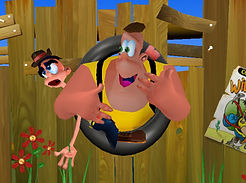
Dave Blanchette: « The team was creative and hard-working, but creating a successful AI character, especially back then, proved to be more complex and time-consuming than anticipated. This delayed milestones and cracks started appearing in the team. »
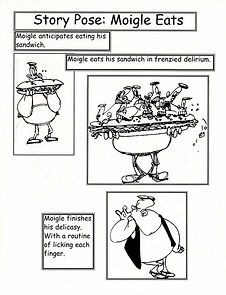
Preparatory work for the Floigan Bros Dreamcast animations: Moigle loses focus and starts eating a sandwich or playing with a toy airplane. When he’s unhappy, he lets everyone know!


A bit of seriousness now — to help Moigle regain his confidence, Hoigle will make an effort to pamper him or play games like High-Five, Hide ’n’ Seek, Catch, Tag, and others. The big guy quickly gets his smile back. On top of that, a series of mini-games are included, such as chasing birds away from a field, activating switches located on narrow pipes, or flushing a cat out of its hiding spot by tossing bombs at it.
Andy Ashcraft: « The mini-games came from brainstorm sessions around what kinds of activities 2 people could do together. In some cases, the two people might be doing the same thing (like running a footrace) or doing two different things (one person planting seeds while the other person shooed away crows.) »
The two make a perfect pair

Despite its eccentricity, the game received mixed critical reviews. Its outstanding graphics and original gameplay couldn’t make up for its shortcomings — namely, its short length and lack of replay value. Even before release, SEGA was well aware that these flaws would hurt VC’s title. Floigan Brothers therefore sparked heated debates over its “reasonable” retail price. The game was seen as too short to justify a price between $30 and $60. A price point between $20 and $30 risked confusing consumers, while a $20 tag would have implied a low-budget game. In the end, SEGA of America’s Marketing and Sales department decided to release it at $29.99. Given SEGA’s situation at the time (the end of the Dreamcast era and its transition to a third-party publisher), sales projections were so low that the game was ultimately considered a financial loss.
Andy Ashcraft: « If I remade the game now, in 2025, with 25 years more experience behind me, I'd push for more re-usable game-play moments so that the game could be more expandable. It would be a challenge, but I can see a version that is larger and more open-world, with more characters to interact with, and more funny things for Moigle to do and get distracted by. »
The Floigan Bros logo strikingly suggests the first episode of a budding franchise. The original plan to develop sequels was abandoned when the game shifted from a platformer to an adventure title. After this change in Gameplay direction, the team realized that the workload required to produce an episodic game was far greater than that needed for the usual expansions accompanying platformers. Too many mini-games to revisit, too many special animations to redesign, too many character behaviors to rework each time…
Andy Ashcraft: « I am very proud of this game, even though it was too short, too late, and didn't sell very well. I had hoped, after I left VC to go work for SCEA, that there would be an 'Episode 2'. I had hoped that Hirokazu Yasuhara (Game Designer known for his work on the Sonic Genesis series) would lead the design from the start »
Completely wacky and unlike anything console players were used to seeing, Floigan Bros. Episode 1 is a Dreamcast curiosity that deserves to be tried at least once!
Floigan Brothers and its development: a game that was trying to find itself
Originally planned to accompany the Dreamcast’s U.S. launch, Floigan Bros suffered numerous delays before finally being released on July 31, 2001, in North America and in November of the same year in Europe. The height of irony — it came out just as the console’s commercial life was coming to an end…
STOPPPPPP !!!!

Andy Ashcraft: « Development started in 1996, I think. I came on in the late summer / early fall of 1997. We were meant to be done by launch (9/9/'99), but the game didn't actually come out until the Summer of 2001. »
In 2001, Sony and Microsoft unveiled their new consoles, while SEGA made a last-ditch effort, firing off the final rounds of the beloved Dreamcast. Consumers preferred to wait and invest their money elsewhere rather than in a red/orange/blue-spiraled game for a console at the end of its life. This unfavorable situation for the blue-hedgehog company, combined with the rushed release of Floigan Bros — hastily completed and lacking a proper promotional campaign — did little to help Visual Concepts title succeed. And yet, it easily held its own compared to the announced Xbox and PlayStation 2 games.
Andy Ashcraft: « I think a game like this would do better now: people don't mind 'episodic' content, and there is a very real market for 'cozy', sweet games like Floigan Bros. »
The tumultuous development of Floigan Bros on Dreamcast did not go as planned, lasting four years. As a result, the game missed its initial release window by 24 months. From the very start and for a considerable time, no clear directives defined FB’s vision. Intractable disagreements among team members only made the situation worse.
Dan Lavender (Animator): « Personally I did not mind working on it for 4 years. It was a lot of fun. It was what brought me to California from Boston. My break in the games industry. »
After these initial setbacks, the game gradually slipped into obscurity until a Visual Concepts executive revived the stalled project. Still lacking a clear direction, the developers spent six months debating trivial aspects, such as: if FB’s protagonists are brothers, why does one have blue eyes and the other green? They focused on minor details instead of making the game fun and engaging to play. The VC lead ultimately decided that the interaction between the two brothers was enough. Floigan Bros was losing its appeal, stripped of substance, with no clear objectives or goals to pursue. Its successful completion seemed in jeopardy!
Dan Lavender: « I spent 2 weeks trying to resolve a banding issue on Moigle's yellow shirt before someone tech savvy told me it can't be done. »
The victory dance

After two years of slow production, Visual Concepts entrusted Andy Ashcraft, a true Game Designer, with the responsibility of taking charge. Undoubtedly, the process of creating and fine-tuning the game’s rules and other core elements had lacked rigor from the start. Ashcraft implemented the mini-games that would give Floigan Bros meaning and enhance the interactivity between Hoigle and Moigle.
Andy Ashcraft: « When we were all working together, there were 12 of us on the team: 3 animators, 2 environmental artists, 5 programmers and 2 designers (including me). That does not include the audio team members we shared with the rest of VC, or the two freelance comedy writers we hired for the project. »
At that point, several artists had just resigned. To prevent their names from appearing in the end credits, the remaining team returned to the drawing board, spending a great deal of time creating new illustrations and backgrounds while maintaining consistency with the initial drafts. To make matters worse, the Floigan Bros team was regularly redeployed to Visual Concepts sports titles, whose development was in full swing, at the expense of working on Floigan Bros.
Andy Ashcraft: « It's true that for maybe 3 months each year, 3-4 of our programmers would need to work on one or more of the sports games. It's hard to make video games without programmers. »
The development of Floigan Bros could finally move forward after several years of uncertainty. The game was at last taking on its own personality. Unfortunately, its successive delays meant it would be released at the worst possible time!
The Making Secrets of Floigan Bros
To translate the comedic spirit of the famous American duo Laurel and Hardy into a video game, the FB team hired not one but two comedy writers, Merle Kessler and Bill Allard. The developers were convinced that, thanks to their professionalism, they would deliver increasingly hilarious jokes and ever-wilder situations between the Floigan brothers.
Moigle’s animations and facial expressions are absolutely wild

Andy Ashcraft: « After I picked Merle Kessler and Bill Allard independently, I found out that they had been working together for YEARS already as founding members of a comedy troupe called 'Duck's Breath Mystery Theater'. They were a joy to work with! »
Hirokazu Yasuhara, a former influential member of Sonic Team, joined the project as a Game Designer at his own request after Floigan Bros missed its launch on 9.99.99. The team was honored to welcome him. Intrigued, Yasuhara had heard about Visual Concepts upcoming title and liked its concept. However, he arrived too late in the development cycle — the core of the game was already set, and production was well underway. As a result, Yasuhara was unable to make major changes, and not all of his ideas could be incorporated into Floigan Bros.
Andy Ashcraft: « My biggest regret is not making more of Hirokazu Yasuhara while he was on the team. In the final shipped project, he created the last area and mini-game that you open up as you play. »
Originally, Floigan Bros on Dreamcast was a platformer. The early animations leaned more toward action. Over time, VC’s title evolved into an adventure game, focusing on AI-driven interactions between the two brothers. The initial intent — for Moigle to constantly follow Hoigle and assist him — remained unchanged.
Dan Lavender: « Spitz ( the dog) was the first character to be implemented. I remember watching as a programmer controlled the dog running around in a very empty environment. »
The kitchen tutorial remains a vestige of the early iterations of Floigan Bros in its platformer form. This section, completed relatively early in the development process, served as a Proof of Concept — a demonstration intended to show the project’s feasibility — before the developers could precisely determine the game’s features. Given the resources and effort invested in creating the map, they decided to keep it. No one considered removing it simply because it didn’t fully align with the rest of the game’s content.
The platforming aspect never completely disappeared, as shown by typical genre mechanics: if the player angers Moigle enough, he will grab Hoigle, turn him into a baseball, and swing him with a bat until he’s sent beyond the horizon. These context-related tricks unlocked new areas to explore in the junkyard and unexpected mini-games. In this way, the progression curve in FB’s story was structured.
Andy Ashcraft: « There were a few 'enemies' in the game, but the enemies couldn't hurt you the same way an enemy might hurt Mario; instead they made Moigle afraid or sad, and it would be up to you (playing his smaller brother, Hoigle) to protect him and make him happy again. »
To captivate players and achieve success, Andy Ashcraft, Dave Blanchette, Dan Lavender, and their colleagues agreed that interaction with Moigle needed to be entertaining and form the heart of Floigan Bros. They devoted considerable time to designing Moigle’s AI objectives and implementing them. Subsequently, the game diversified by incorporating a series of mini-games in which the player would take control, accompanied by Moigle managed by artificial intelligence.
The bond of two brothers

Good old Moigle

Andy Ashcraft: « Initially, we thought that platform-style puzzles would be the central challenges players faced, but after a few iterations of that, we found that to be very repetitive and and Moigle could be annoying to have to manage. »
The AI detects only a few “needs” that Moigle experiences: Affection, Play, Hunger, Sleep, and Safety. These sensitivities gradually diminish over time, and it is up to him to address them at the appropriate moment. Objects and locations in the game suggest actions to fulfill his vital needs. Once these needs reach a sufficiently high level, he engages in other activities to satisfy lower-priority desires. Hoigle (the player’s character) regularly intervenes to assist him in this task. For example, when Moigle’s affection level drops too low, he seeks a hug from his brother. He can also manage on his own, such as finding a place to lie down for a nap to recover emotionally.
When the AI requires Moigle to change his behavior, the game gives him a brief window to respond. In other words, when he performs any action, a trigger can sometimes prompt the AI to suddenly adopt a different reaction. Moigle then pauses, observes the factor that caused the behavior change, and waits one to two seconds before moving differently. This subtlety helped shape the game and reassured the Floigan Bros designers as they continued its development.
My precious key

Andy Ashcraft: « It looked like he was thinking about what to do, but it also gave you an opportunity, if you were paying attention, to either help him, or distract him with something else. That little delay ended up being the key to making him feel like a 'real' cartoon character. »
Visual Concepts extravagant title introduced twelve DLCs, ranging from cosmetic items (Halloween Costume, Baseball Cap, Valentine, Presents In the Mail, Easter Egg Hunt, etc.) to a new mini-game. The studio planned to release one per month over the course of a year. Unfortunately, much of this additional “downloadable” content never reached the public and was ultimately canceled. Fortunately, all of FB’s DLCs have been accessible since 2017 thanks to a game file hack (link to obtain them). It’s worth noting that it is technically incorrect to call this “Downloadable Content” in the case of Floigan Bros. Episode 1 — and possibly for the Dreamcast in general — because the player was not actually downloading anything. The data, already stored on the GD-ROM, was simply locked to prevent use before a specified date.
Andy Ashcraft: « Sega was pushing the fact that the Dreamcast was the first console to launch internet-capable, BUT people's download speeds were very, very slow. We had a series of monthly 'downloads', like my favorite: a 'Mom' costume for Moigle. All of these things were on the diskette. The game queried a server for a date, and then unlocked the content on that date. So, we WERE using the modem, but you did not need to actually download anything. It would have been too slow. »
In the final stages of Floigan Bros development, while beta testers worked to detect even the smallest bugs, the developers stayed up all night monitoring the GD-R burning process (the red Dreamcast prototypes). Burning a single disc took about an hour, with an unusually high error rate of 80% (to be cross-checked with other studios). Visual Concepts had approximately five GD-Writers — devices linked to a Katana Development Kit that allowed the burning of blank GD-ROMs. SEGA’s QA department (the service ensuring a product meets set standards) required ten functional discs of the current game revision each morning to start a new day of testing.
Who would have thought that the development of Floigan Bros would be marked by so many highs and lows, and so many challenges?
The December 13, 2000 Prototype
An examination of the prototype shows that the GD-R of Floigan Bros for Dreamcast was burned on December 13, 2000, at 19:24:22. This beta of Visual Concepts little-known game predates the final NTSC-U version by eight months, which was released on July 6, 2001. This snapshot of Floigan Bros: Episode 1 development provides an excellent insight into the evolution of its level design and the implementation of its dialogue lines.
Floigan Bros Dreamcast Prototype Trailer
The file ANITEST.IFF, deleted before the game’s release, is intriguing — it may have been an Animation Viewer. The GAME.ELF remains the most fascinating of all, suggesting that this version of Floigan Bros, like the recently shared Dreamcast beta of Space Channel 5 Alpha or the PlayStation 2 beta of Fear Effect Inferno, contains Debug Symbols. For reverse engineering enthusiasts, this essentially provides a way to access the game’s code. The NHL 2K Dreamcast builds from Visual Concepts preservation project also include “.ELF” files.
The reverse engineering work by graphics programmer and streamer Astrid (aka Teloru, thanks to her), assisted by Nehalem, shows that the dialogue writing in this version of FB was far from final. Comparing the text displayed on this prototype to that of the final version is striking — matches are minimal, if not almost nonexistent. Teloru’s GitHub account hosts the UNLZVC Decompressor, a tool designed to decompress the game’s dialogue strings. To explore this aspect of Floigan Bros further, download the comparative dialogue pack of Visual Concepts title below:
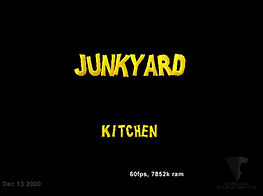
A watermark constantly displays Visual Concepts name and logo on the screen. This FB prototype also continuously shows system information, such as FPS and RAM usage.
The game starts directly on its title screen, skipping the usual splash screens that normally precede it. A shame, as the short animation showcasing the studio’s emblem in the final version fits perfectly with Floigan Bros’ quirky style!
The prototype’s title screen, lacking the “© SEGA Corporation 2001” copyright and the usual upbeat music, does not match the familiar version. Instead, it is a still frame from the game’s intro cinematic at the GOLD stage. From this observation, there is a significant difference between the title screen of this intermediate Floigan build and the final version.
Inside the Prototype and Its .ELF File

Prototype

Final Version

The dialogue lines

The save system appears to be nonfunctional. No VMU-related Menu bridges the gap between player and console, even though the “SAVE” option is already included in the Pause Menu. The memory card displays nothing on its screen.
The Main Menu does not offer access to “Options” or the ability to resume a game (“Restore Game”). In the prototype, this Menu is displayed in a rudimentary way: a level selector with a black background, allowing play in either the “Junkyard” (final version: Moigle's Secret (Game)) or the “Kitchen” (final version: Cookies! (Tutorial)).
The cinematic sequence preceding the title screen and the one introducing the junkyard level are significantly shortened in the prototype. The kitchen scenes do not yet exist.
The level selector
The kitchen’s white textures

In the final version, when the “cursor” selects one of the four options in the Pause Menu, each is highlighted with a distinctive color and a font size change: CONTINUE (green) – SAVE (dark grayish purple) – RESTORE (bright purple) – EXIT (orange/red). This is not the case in this FB build.


Some parts of the kitchen scenery appear in white and lack their proper textures.
Interactive progression elements are missing in the kitchen, preventing the tutorial from being completed. At this stage of development, the level is simply explorable. In the junkyard, faulty mechanisms block the player from completing FB’s adventure.
Bugs allow access, from the very beginning of Moigle and Hoigle’s adventures in the junkyard, to areas that would normally unlock later in Floigan’s story progression (for example, in the video at 2:16).
The directive interface for interacting with Moigle, accessed via the “Y” button, uses a bicycle-wheel design divided into eight segments instead of a pile of wood. The order of controls for Hoigle’s brother varies between versions. The prototype does not inform the player with green explanatory text about the purpose of each command in this Sub-Menu.


In this early form, the game sometimes displays the message “missing string” to indicate that textual data is missing.
An animation removed from the final version?

The prototype does not allow Hoigle to fall into the riverbed running through the junkyard as in the final version. A funny animation of the playable character losing balance prevents it.
The more differences there are between versions, the more prototype enthusiasts tend to enjoy it, right?
Comparative Photos
A clear evolution of the level design and graphical environment of Floigan Bros’ levels can be observed in the eight months separating this build from the GOLD version. The backgrounds underwent major transformations, likely corresponding to the period when some artists redrew them after others had resigned, as noted in the chapter [In the Shoes of Hoigle and Moigle: A Comical Video Game Scene]. As is often the case, here are a few non-exhaustive comparative photos of the changes made to Floigan Brothers on Dreamcast, as of December 13, 2000 (prototype on the left, final version on the right).
Junkyard (Final version: Moigle's Secret (Game))
The carpenters were not satisfied with the quality of the wood initially chosen. They demolished the Floigan brothers’ little house to rebuild it with a more refined material. Moigle and Hoigle, unhappy with the lackluster appearance of the advertisement, begged the developers to make it more striking for the game’s launch.


Nobody knows this, but Hoigle met a woman during the final phase of Floigan Brothers’ creation. The level designers, aware of this budding romance, placed a flower bed near the house so Hoigle could pick flowers and give them to his beloved each evening after his misadventures in the junkyard. To ensure Hoigle could spend some one-on-one time with her, away from Moigle, the VC team placed a crate with an apple on it to distract the ever-hungry genius!


The designers of Floigan Brothers felt that the blue crate, which cues players to trigger a key event by making Moigle cry, was too close to the river. No problem — they just had to move it a few meters back!


Just like in real life, it can rain in a virtual world. Fortunately, the Ferris wheel wasn’t left exposed to the elements for too long without protection! And what about the other peculiarities of this build…


While this photo comparison between the FB prototype and the final version reveals many differences — such as textures, background, the placement of the green crate, and the barrel model — the feature that stands out most is the green marking and cardboard material of the crate behind the pulley system.

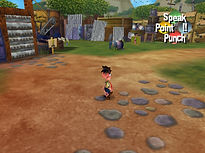
During the game’s beta-testing phase, Moigle frequently suffered from indigestion. He was no longer able to assist Hoigle and would spend the entire day sleeping. Visual Concept decided to reduce the number of apples available in the level and remove those behind the Floigan brothers’ junkhouse, making it less likely for Moigle to overeat. In the prototype, the house was not yet connected to the electrical grid — the line installers had not begun setting up the power poles.


In the final version, Moigle, ever absent-minded, was no longer at risk of falling off the roadside while climbing the hill. Safety first! Did the junkyard originally house a megalithic site like the famous Stonehenge? Hmm, those rocks…


In the prototype, Hoigle and his brother were unable to climb onto their house’s chimney to survey the surroundings. The game designers added a ladder at their request so they could enjoy a panoramic view of the junkyard from the highest point in the area.


This change is not trivial and goes beyond the mere aesthetic aspect of the level. In the prototype, a bug allows Hoigle to pass through the wooden fence in front of him. Since a ladder is located on the other side of the fence, the character assumes he can climb it from that side as well. As a result, he ends up in the area with the dog Spits — a location that players cannot normally explore at the beginning of the game (see the video at 2:16).


Kitchen (Final version: Cookies! (Tutorial))
Temporary or default white textures, like the color of the flour that Moigle searches for in the tutorial to bake cookies. Coincidence?

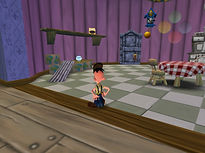
How did Santa Claus deliver presents to the two brothers without being able to go down the chimney? Poor Moigle and Hoigle were left out in the prototype…


The blue hue of the wallpaper in the final version gives the Floigans’ home a more refined look, whereas the beige gives the room a less contemporary feel. Additionally, the designers didn’t want Hoigle and Moigle to become addicted to the TV, which is why they decided to remove it later. A window replaced it — might as well have a screen that reflects reality!


This photo representation of Floigan Bros’ evolution highlights a game in constant flux and provides context for the testimonies of its creators.
.jpg)
You can download this build of Floigan Bros Dreamcast below
The other Floigan Bros Dreamcast prototypes
No in-depth research has been conducted on the prototypes listed below. They are available for direct download.
.jpg)
This article is dedicated to the Floigan Bros Dreamcast betas. It serves as a supplement to the article focused on the work of Visual Concepts, covering the making-of of their iconic titles, with exclusive testimonies that put them into perspective, as well as the Dreamcast prototypes of: Floigan Bros.: Episode 1 - NFL 2K1 - NCAA College Football 2K2 - NBA 2K - NBA 2K1 - NBA 2K2 - Fantasy Prototype (Proof of Concept) - NHL 2K - NHL 2K2 - World Series Baseball 2K2 - Over The Top Soccer (Unreleased) - ToeJam & Earl III Mission to Earth (Unreleased) - Ooga Booga. Discover the entire preservation project dedicated to this talented SEGA-affiliated studio on following page: [The Rise of Visual Concepts in the SEGA Era: Prototypes and Behind the Scenes of the Making of Their Dreamcast Classics]
I would like to thank Andy Ashcraft, Dave Blanchette, Cord Smith and Dan Lavender for their availability, kindness, for taking the time to answer my questions, and for providing me with concept material. Their testimonies allow us to travel back in time to the development of Floigan Bros on Dreamcast and to understand the challenges faced during its creation.
Special thanks to:
-
Antoine MERIGNAC for proofreading and correcting the French text
-
Neil Riddaway for the English translation of the article
-
Astrid and Nehalem for their expertise on the dialogue lines
-
Megavolt85 for decoding the .ELF file
Really special prototypes (big differences, early Builds, weird ones, etc.): Guilty Gear X (DC) - Dead or Alive 2 (DC) - Samba De Amigo (DC) - Virtual-On Oratorio Tangram (DC) - Spirit of Speed 1937 (DC) - Re-Volt (DC) - Phantasy Star Online (DC) - San Francisco Rush 2049 (DC) - Evil Twin: Cyprien's Chronicles (DC) - Toy Racer (DC) - Space Channel 5 (DC) - Sega Smash Pack Vol.1 (DC) - Red Dog (DC) - Propeller Arena (DC) - Half-Life (DC) - Jet Set Radio (DC) - Daytona USA 2001 (DC) - Floigan Bros. Episode 1 (DC) - NBA 2K1 (DC) - NFL 2K1 (DC) - NHL 2K (DC) - World Serie Baseball 2K2 (DC)
More than 300 prototypes have been digitized. You will find them available for free download in the section: [Dreamcast prototypes (and more) available for download]
