


Fantasy Dreamcast Prototype: the true definition of a video game prototype, with this Proof of Concept by Visual Concepts
In 2001, SEGA shocked the video game industry and its fans by announcing the end of Dreamcast production barely three years after its launch. Shortly thereafter, the already fragile house of cards of the Japanese manufacturer, weakened by the Saturn era, collapsed within a few months. Gamers, feeling betrayed, turned to competing consoles such as the PlayStation 2, GameCube, and Xbox to satisfy their passion. Development studios and publishers immediately ceased supporting the Dreamcast, once full of promise, now considered commercially obsolete. A tragic fate!
Fans witnessed a multitude of game cancellations originally intended for the Dreamcast. Some were released elsewhere, while others were not so fortunate and joined the graveyard of Unreleased titles that died whit the console.
For more than 20 years, enthusiasts, video game historians, preservationists and archivists have been hunting the Dreamcast Unreleased titles, striving to document them, analyze them in the smallest details, or share them with the community in one form or another. The goal, whether through visuals, stories from their creators, or ideally by playing them, is to understand their concepts and glimpse what they were like. Indeed, for some of them, SEGA’s downfall led to their cancellation. It is also an opportunity to give them the visibility they should have received had they been released, and to honor the people behind the scenes who worked on them for weeks, months, or even years.
This relentless hunt for aborted Dreamcast projects made it possible to unearth and write the history of cancelled games that made headlines such as Agartha, Castlevania Resurrection, Propeller Arena and Half-Life. Soul Reaver 2 and Black & White remain undiscovered to this day. In hindsight, retro-gaming archaeologists explored only the tip of the iceberg of Unreleased titles on SEGA’s final console: the officially announced games. What about the submerged part, with titles that were never revealed yet were playable? Recent discoveries such as Jekyll & Hyde (playable), Ring: The Legend of the Nibelungen (playable), Traveller: Space Lords (functional demo but not truly playable, unavailable), Stampede (playable but unavailable) or Bad Mojo (unplayable, cancelled early during the Dreamcast port) suggest the existence of a significant number of such games developed in the greatest secrecy. Moreover, everyone seems to ignore a lesser-known aspect of the medium: unapproved Proofs of Concept (demonstrations of the feasibility of an idea, a project or a method before heavily investing in its development). There are probably dozens of them!
Kamehameha (Fantasy Prototype DC)
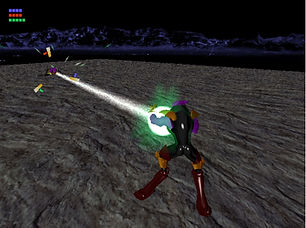
The Visual Concepts Fantasy Prototype game presented in this article most likely belongs to the Proofs of Concept category. No one seems to remember its development or the reasons why its concept was rejected. It is not the only project that was turned down by the California-based studio. During investigations aimed at learning more about it, a former VC employee revealed that he had tested a ‘capture the flag’ type game featuring demon characters. Perhaps an early iteration of Ooga Booga on Dreamcast…
It is extremely rare to uncover Proofs of Concept, especially when they never go beyond that stage in the birth of a video game. Is it appropriate to describe Fantasy Prototype as an unreleased title in this context? It might be more relevant to call it a true prototype!
Proofs of Concept in Game Development
A Proof of Concept in the creation of a video game serves as an initial step to validate its concept, test it, and refine its core features before deciding whether to continue its development. It allows experimentation with game mechanics without committing to full-scale production. In short, this is the true definition of the term ‘prototype,’ which is often misused today to refer to a version of a game that differs from the commercially released one.
Video game development does not follow a set procedure. Each company decides whether a future game requires a Proof of Concept. Companies in the industry have different ways of working, and this also applies to studios under the same publisher, each managing submitted projects in its own way. Sometimes, developers test a game concept before fully committing to its development (certainly the case for Fantasy Prototype). Other times, things proceed without any targeted testing at all.
In the realm of video game development, this world is full of stories about projects that were started without prior authorization from a studio’s executives, or during the free time of one or more developers, which somehow make their way up to the higher levels of the studio or publisher—sometimes based on a Proof of Concept. Here are a few examples of individual or collective ‘initiatives’ that were approved, rejected, or never even submitted for review:
-
Virtual On Arcade (approved): The story begins with a handful of AM3 employees, driven by their passion, secretly developing a video game without the studio’s or SEGA’s permission. However, someone outside the core group eventually discovered it. The project was ultimately presented to the management team, who gave their approval to continue. Had their reactions been negative, things could have taken a very different turn…
he official Dreamcast Mega Drive emulator

-
Sega Swirl Dreamcast/PC (approved): For three weeks, outside of office hours, Scott Hawkins coded a puzzle game called Sega Swirl. One day, he decided to show it to Shinobu Toyoda (Executive Vice President of SOA). His superior at SEGA of America, delighted by his initiative and the small game, allowed him to continue its development professionally within the company.
-
The official European Mega Drive emulator for the Dreamcast (under discussion): David Harvey, a programmer in SEGA Europe’s developer support department, was working on a Mega Drive emulator for the Dreamcast as a way to learn programming. Elton Bird assisted him by optimizing its performance. As the project took shape, people at SOE, aware of its existence, considered publishing it—but by that time, the Dreamcast was taking its final breaths!
-
VMU RPG Dreamcast (not approved): At SEGA of America, Alex Villagran, the creator of VMU Football (released on September 29, 1999, on the company’s official website) and also responsible for mastering demo discs for the American market, excelled at programming mini-games for the VMU. He decompiled the one from Time Stalkers (Climax Landers) to create a new one. Then, in collaboration with his colleague Marc Cellucci from Sega.com (SOA Web Department), the two designed a complete map, formalized the mini-game concept, and created sprites. Their VMU RPG was roughly functional before their supervisor put an end to their ambitions. There was still a lot to do, such as enemies, story, and more.
-
Geist Force 2 Dreamcast (never discussed with SEGA): During his free time, Christian Senn imagined a sequel to Geist Force for the Dreamcast while he and his colleagues at SEGA Product Development were working on the original game. His aspirations for Geist Force 2 were limited to concepts and sketches. He planned to later share his ideas with the development team for a second installment if the first game succeeded. Unfortunately, Geist Force 1 never saw the light of day…
-
Isle Dragon PlayStation 1 (not approved / bad outcome = dismissals): Régis Carlier, Arnaud Neny, Thierry Doizon and their colleagues, alongside the projects Cryo Entertainment had assigned them, began developing Isle Dragon for PS1—a fusion of Ghosts ’n Goblins and action RPG gameplay, featuring a modern Tomb Raider-style aesthetic. They presented an initial prototype of the game at E3 1998 or 1999 to approach a publisher, notably Interplay. A few months after this Isle Dragon demonstration in Los Angeles, a magazine published an article about it. A jealous Cryo employee, reading the specialized press, informed Cryo management about their unauthorized side project outside the studio’s official games. While the small team was negotiating with publishers, Jean-Martial Lefranc, Cryo’s CEO, summoned them and immediately torpedoed the project by contacting all potential Isle Dragon partners and fired them!
Very short video of Isle Dragon (PlayStation 1)
Behind the video game industry, which has captivated the world since the 1970s, lie thrilling human stories. It is up to us to highlight them and to explain, in a simplified way, the steps involved in developing a video game, especially the lesser-known ones!
The Fantasy Prototype prototype of February 3, 1999
The examination of this Dreamcast Proof of Concept indicates that it dates back to February 3, 1999, at 13:14:20. This beta offers the opportunity to briefly test the gameplay mechanics and rules of this Visual Concepts title, provisionally named Fantasy Prototype. This unusual project is reminiscent, in its gameplay, of MDK 2 or Red Dog.
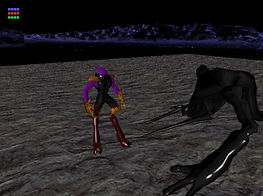
An untextured satyr
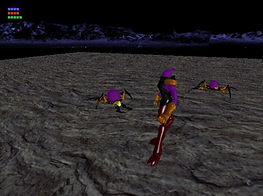
Not for arachnophobes
Structure of the game files

Fantasy Prototype Dreamcast trailer
Only the vertex colors are displayed. This usually happens when no texture is applied to the model.
The player moves across a tiny square arena devoid of any decorative elements. They control a Satyr, a half-man, half-goat entity from Greek mythology. Fantasy Prototype may be inspired by a graphic novel or comic book, such as those from the Marvel Comics universe, depicting these fantastical beings associated with gods like Hercules and Thor (Power: Manipulation of mystical energy). Several four-legged spiders, as well as a formidable black creature with a long tail, roam the map. Naturally, the goal is to annihilate them!
The developers did not dedicate any time to the sound aspect of the ‘concept’. For them, the main focus was to test the interaction with the game, controller in hand, in Fantasy Prototype. Audio was of little importance.
A game session never ends. The evil black creature keeps reappearing endlessly, even after being defeated.
It is exciting for an ordinary person to access this type of prototype, which is usually reserved for industry professionals.
Game Mechanics
The protagonist has three distinct spells: Water (purple/blue), Fire (orange/red), and Nature (green). By pressing ‘Y’, the player opens a wheel-shaped menu displaying them, then selects the most appropriate one for the situation using the controller’s analog stick. The Satyr’s laser beam color then changes according to the chosen spell.
The user interface, located at the top left of the screen, displays three bars – blue, red, and green – each initially composed of four squares at the start of a game. They represent the number of casts available for each spell, intended to fully damage an opponent.
The visual targeting indicator on enemies uses the same principle as the HUD, except that for them, the squares show their vulnerability to the Satyr’s abilities in Fantasy Prototype. In simple terms, it is their health bar, always linked to the spells used by the game’s hero.
The spell selection wheel

Holding down the ‘A’ button allows continuous shooting. There are two specific attacks. The first technique involves pushing and holding the analog stick down while firing, which absorbs the opponent’s energy points and deals damage. The second, by holding and pushing the analog stick up while shooting at the enemy, restores their health. Both types of attacks affect the ‘ammo stocks’ (i.e., the squares) in the HUD, either decreasing or increasing them, as well as the damage indicators on the enemy targets. To eliminate them completely, no red, blue, or green squares should remain on the targeting aid.
Energy recovery

The game mechanics remain opaque—why restore HP (or power/mana) to a hostile creature with nothing more than a visual effect in the targeting reticle? Unfortunately, only the VC developers who worked on this POC hold the answers. It would be easy to get lost in fruitless speculation:
-
A Chain/Combo system like in some puzzle games?
-
Adaptation of an existing physical game?
-
Inheritance from the original material if based on a comic?
Now it’s up to you to put forward your guesses and try to understand why the Fantasy Prototype concept was not approved!
You can download this build of Fantasy Prototype Dreamcast below
Important:
The DEmul and nullDC emulators do not seem to work for playing this Visual Concepts Proof of Concept. The game may crash on certain versions of Flycast.
To Read: The prototype extraction process generated errors, but the build is still playable nonetheless. Due to unfavorable global circumstances, I was unable — as I usually do when dump issues occur with the BBA method — to send the GD-R (GIGABYTE DISC RECORDABLE) to Saizpaimon for a clean scan using the Redump process. Kailokyra attempted to handle it on their behalf but was unsuccessful. Consequently, Ehw manually corrected as many errors as possible using the numerous incomplete BBA and Redump dumps made from the disc, resulting in a so-called “Frankenstein” version.
This article is dedicated to the Proof of Concept of Fantasy Prototype. It serves as a supplement to the article focused on the work of Visual Concepts, covering the making-of of their iconic titles, with exclusive testimonies that put them into perspective, as well as the Dreamcast prototypes of: Floigan Bros.: Episode 1 - NFL 2K1 - NCAA College Football 2K2 - NBA 2K - NBA 2K1 - NBA 2K2 - Fantasy Prototype (Proof of Concept) - NHL 2K - NHL 2K2 - World Series Baseball 2K2 - Over The Top Soccer (Unreleased) - ToeJam & Earl III Mission to Earth (Unreleased) - Ooga Booga. Discover the entire preservation project dedicated to this talented SEGA-affiliated studio on following page: [The Rise of Visual Concepts in the SEGA Era: Prototypes and Behind the Scenes of the Making of Their Dreamcast Classics]
I would like to thank, for their availability and kindness, everyone closely or remotely connected to SEGA or Visual Concepts with whom I have spoken. Their expertise in the industry helps us better understand what a Proof of Concept is in the world of video games.
Special thanks to:
-
Hicks for proof-reading the French text
-
Tom Waterhouse for the English correction of the article
-
Saizpaimon from Hidden Palace for his expertise with the Redump method in extracting data from the prototype
-
Kailokyra for attempting to preserve the prototype by scanning it with the Redump method, even though it was unsuccessful
-
Ehw from Hidden Palace for minimizing extraction errors as much as possible (the “Frankenstein” build)
Similar prototypes (Unreleased): Agartha (DC) - Emulateur officiel Megadrive (DC) - Castlevania Resurrection (DC) - Half Life (DC) - Dalforce XOP (DC) - Flinstone (DC) - 4 x 4 Evolution PAL (DC) - Ring : L'Anneau des Nibelungen (DC) - Ecco 2 (DC) - Kyskrew (DC) - Propeller Arena (DC) - Geist Force (DC) - Scud Race Tech Demo Dreamcast - Shenmue 2 US (DC) - The Red Star (XBOX) - Heaven's Drive ( version japonaise de Burnout 1) pour PS2 - Jekyll and Hyde (DC) - The Grinch Jap (DC) - Worms Pinball (DC) - Quake 3 Arena version japonaise (DC) - Vectorman (PS2) - Fear Effect Inferno (PS2) - Over The Top Soccer (DC) - Fantasy Prototype (DC) - ToeJam & Earl III (DC)
Feel free to try out [The Dreamcast Unreleased Games to Download] that I found. For the more curious among you, I also wrote [The List of Cancelled Dreamcast Games], which references all of them along with information about each title.
