


Daytona USA (2001) Dreamcast: Races filled with prototypes
SEGA's announcement of Daytona USA (2001) for the Dreamcast at the “Dreamcast Premiere” event during ECTS 2000 in London came as a big surprise. As soon as Daytona USA appeared on screen during the presentation of upcoming SEGA games, the audience erupted in cheers. No one expected the iconic Saturn title to land on the Dreamcast. The wishes of Arcade enthusiasts had been granted!
In reality, this is not a new version in the strict sense of the term, but rather an improved version of the first installment, based on its Arcade and Saturn versions. Daytona USA 2001 for the Dreamcast features three new tracks: Pixie Circuit, Rin Rin Rink, and Mermaid Lake, as well as a Grand Prix mode and the option to play Online. It was one of the first racing games to offer an Online multiplayer mode. The game remains unchanged: the goal is to be the first to cross the finish line.
Daytona Dreamcast Prototype footage
With the advent of the Dreamcast in 1999, SEGA had the idea of designing a modern version of Daytona USA that could compete with other popular racing games, such as Gran Turismo on the PlayStation. At the time, the Dreamcast was facing competition from Sony's PlayStation 2. SEGA hoped that Daytona USA 2001 would help expand its game catalog and attract players. Toshihiro Nagoshi, known for his work on the Super Monkey Ball series and later on the Yakuza series, was put in charge of development at Amusement Vision, an internal division of SEGA.

One of the main objectives of the project was to revamp its visuals. The development team took advantage of the Dreamcast's technological advances to offer high-resolution textures, more detailed car models, richer environments, with reworked lighting and shadow effects, and smoother animations. Daytona USA 2001 for the Dreamcast was capable of running at 60 frames per second, which was an impressive feat for its time.
The Amusement Vision team didn't stop there. They took the opportunity to revamp the controls, offering a more realistic experience while preserving the fast-paced, accessible Arcade Gameplay of the first game. The soundtrack was also revised to include updated versions of classic songs, as well as new original tracks.
Pure Arcade driving, thrills, memorable music, epic tracks... There was no doubt about it, it was the legendary Daytona USA that was coming to Dreamcast. Rolling Start!
The prototype of October 21, 2000
Analysis of the build suggests that this prototype was created on October 21, 2000 (1:24:46 p.m.). This version (V 1.024) of SEGA's famous racing game predates the final Japanese edition (V 1.04, December 6, 2000 (9:04:09 p.m.)) by about 45 days. At that precise moment, Amusement Vision was beginning to implement the Online mode and website for Daytona USA 2001 for the Dreamcast. The beta's main appeal lies in its audio, the appearance of the in-game announcer, and its Online multiplayer features.
The build reveals a striking number of files that do not appear in the final version. They seem to be related to the Internet/Online portions of the game and its musical compositions. Some are similar to placeholders used temporarily for the website(s).
The kind of prototype that holds many secrets


At the time, SEGA did not hold the license for the Daytona brand. Hasbro Interactive, one of the three publishers that owned it, participated in the release of Daytona USA 2001 for the Dreamcast. The game normally starts with a copyright screen indicating the involvement of this American subsidiary of Infogrames Entertainment (formerly Hasbro). The prototype makes no mention of Hasbro Interactive when it runs. It also does not display the Splash Screens with the Amusement Vision, Genki, and Wave Master logos. The build launches with a window that does not exist in the final version — one with a white background and the words “PRESENTED BY SEGA”.
Presented by SEGA hé hé hé

The memory card (VMU or VMS) displays a temporary Daytona Dreamcast logo, with the game name in italics, using a plain font without any special effort to make it stand out.
Don't forget to check the VMU screen
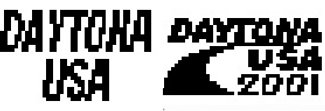
What can be said about the title screen other than that its design resembles that of the Arcade and Saturn versions of the game rather than its Dreamcast counterpart? This is undoubtedly the most surprising, striking, and intriguing difference!
Whenever it appears, the build borrows the logo from the 32-bit version of Daytona USA. At this stage of Amusement Vision's game development, it did not have its own logo to distinguish it from other entries in the SEGA franchise.
Attract mode has its own set of peculiarities. Watermarks from the development studio and console manufacturer are visible on the screen throughout the auto demo. The developers removed them in the final version and moved the Daytona USA logo from the left to the right.
The validation sound effect when navigating through the Menus does not match the one used later on.
The practice of releasing a video game worldwide on the same date began tentatively toward the end of the Dreamcast's life cycle. Previously, players often had to wait several months after players on other continents to enjoy a game. The choice of language (ENGLISH/JAPANESE/GERMAN/FRENCH/SPANISH) in “Game Config” in the Options Menu may suggest that SEGA intended to release Daytona USA 2001 for the Dreamcast worldwide. This was not the case. Only the prototype has this functionality. Once the language has been changed, the build asks you to save the game when you exit the Options Menu. Only English and Japanese are operational, with slight differences in the layout of the box that informs the player of the actions to be taken and when it appears on the screen.
This Daytona logo is well known

The game offers the opportunity to listen to the musical themes and sound effects of Daytona USA 2001 for the Dreamcast at your leisure, thanks to the “BGM TEST” and “SE TEST” options in the “GAME CONFIG” Menu. The prototype includes more music (109 instead of 64) and more sounds (100 instead of 45). This article takes a closer look at the game's audio in more detail below.
Oops, we didn't see anything

There is a glaring spelling mistake in the box on the left side of the vehicle on the “MAIN SELECT” screen. “TRANS MISSION” should be one word!
For certain circuits, the prototype allows less room for error than in the final GOLD version. The difficulty level, i.e., the maximum time allowed to reach the next checkpoint, was adjusted during the month between the two versions. For example, at the start of the Sea-Side Street Galaxy race, the countdown timer shows 66 seconds instead of the usual 75.
The cursor representing the player's car on the mini-map of the user interface is turquoise instead of the usual red.
Finishing in first place in a Championship mode race earns only 80 points in the overall standings. This value was increased to 100 before the release of Daytona USA 2001 for the Dreamcast in Japan.
The default camera angle in local multiplayer mode (VS BATTLE) offers a reduced field of view of the track's outdoor environments compared to its preset configuration in the final version. The VS BATTLE Submenus inform both competitors that pressing the “A” button confirms their selection and pressing the “B” button takes them back. These instructions disappeared during the final stages of the game's development.
The prototype symbol (left: build, right: final version)


80 or 100, it doesn't matter, you have to finish first


Perfection in every detail


75 seconds isn't enough, so 66 seconds is definitely not enough


A worldwide release window certainly being considered


Players want to see the entire track


Amusement Vision was making last-minute adjustments and final tweaks to Daytona USA 2001 before its release on Dreamcast in Japan. Nothing incredible to report above, but below...
Audio and the secrets of the prototype
The prototype contains around 170 ADX audio tracks, including music and sound effects, which were removed when development of Daytona USA 2001 for the Dreamcast was completed. Some of these tracks show that the Amusement Vision team had just validated, from among several different interpretations and intonations for the same word or phrase, and implemented in the game the characteristic voice-over of SEGA's arcade titles. These are remnants of the process of setting up the announcer in the game. One example among many is that the developers preferred “Ladies and Gentlemen, start your engines” to “Gentlemen, start your engines”.
Gentlemen start your engines (not validated)
Ladies and Gentlemen start your engines (validated)
Apparently, the employees at AV were considering including voice announcements in menus that ultimately contained none, such as those for the online multiplayer mode. Having them play everywhere and for every minor on-screen adjustment would have quickly spoiled the pleasure of hearing them.
Net Battle (not validated)
Now list your name (not validated)
Records (not validated)
Replay (not validated)
Championship (not validated)
Option (not validated)
Arcade (not validated/non-existent game mode)
The voice actor sometimes mentions enigmatic names, including Arrowhead, Jumbo, and Pon. Are these car models that didn't survive the development of Daytona USA 2001 Dreamcast?
Arrowhead
Jumbo
Pon
ADX files reveal the existence of a previously unknown game mode, Arcade mode, which may have been sacrificed during the development of the Dreamcast version of Daytona USA 2001. The build includes the entire soundtrack (ADXB_065 to 081), including secret songs (ADXB_082 to 108). A trick on the Arcade terminal was to enter specific three-character names in the leaderboard after a race to listen to hidden music (V.R = Virtua Racing):
A.B = After Burner
H.O = Hang On
O.R = Outrun
You can download an Excel spreadsheet of Tom Waterhouse's research on the audio of the Daytona USA 2001 Dreamcast prototype below:
Detailed audio analysis of the Daytona USA Dreamcast prototype (October 21, 2000)
Who would have thought that simple audio files could provide so much new information about the game's development?
The website
The Main Menu option for accessing the Daytona USA 2001 Dreamcast website is temporarily called “BROWSER”. It will ultimately be named “HOMEPAGE”. The layout of the website's home page differs from the one that Japanese users will see. This is where consumers will see the first and only appearance of the actual Daytona Dreamcast logo on the prototype, albeit with unusual fill colors. When left idle for a long period of time, the build displays various patterns on the screen that do not match the final version (the .GIF files contained in the “DPSS” directory after extracting the game data).
Prototype

Final Version

This process of logging into the Genki website is strange

When the red GD-R (GIGABYTE DISC RECORDABLE) was burned, two icons directed players to the main Genki website (semi-operational) and Amusement Vision (non-operational). The webmasters later abandoned these redirects in favor of a link to SEGA's DreamHome (Dricas) service. They also added an Online ranking that could be viewed through “NET TIME RANKING”. Note that the image of the globe does not yet react when the cursor is moved over it.
By clicking on the thumbnail of Genki, the development studio behind Tokyo Xtreme Racer 1 and 2 Dreamcast, the prototype unsuccessfully attempts to visit the website of the Japanese company that collaborated with SEGA on Daytona USA 2001. Before failing, the connection process takes place in a window with a green background. It displays models in .nj format (placeholders?) briefly explained in the chapter: [The October 21, 2000 prototype].
Something else strange

Dreamcast game prototypes rarely contain drafts of their websites under construction. This beta version of Daytona USA highlights the behind-the-scenes work of webmasters and the evolution of video game website design.
The Online mode
When attempting to play Daytona DC Online, a basic configuration Menu for connecting to its servers (equivalent to “Select Provider” in the American version) appears immediately without offering to load a save file, without warning the player with messages, and without allowing them to consult the game's terms of use before proceeding. The title of the Online mode, “NET BATTLE” on the prototype, was renamed “DAYTONA USA NET BATTLE” when SEGA's title went GOLD.
What would the game lobbies look like if we could skip these menus and actually connect online?


The white text on black, considered a placeholder, serves as a temporary support for the final Menu to come. As it stands, the wording at the top outlines its interactivity. AV programmers have made it roughly functional in order to already perform Online tests of Daytona USA Dreamcast. What can be said about the virtual keyboard...
Daytona USA 2001 Dreamcast, in its prototype version dated October 21, 2000, provides a glimpse into the implementation of online modes in video games at the dawn of the second millennium.
Conclusion and download links
At first glance, the build doesn't look like much. In concrete terms, the evolution of the development of Daytona USA 2001 for the Dreamcast between October 21, 2000, and December 6, 2000, is not noticeable to the naked eye, or only slightly so. Among other things, it does not include a Debug Menu, which would have made it more interesting to play the title in this format. Its main specific features concern aspects of the game that are relegated to the background, such as:
Let the race begin
-
Implementation of an Online mode
-
Implementation of voice-over
-
Implementation of a website
By digging into the depths of the prototype, even though we only skimmed the surface of its structure, it indirectly provides new information about the Dreamcast port of SEGA's most famous racing game and the developers' initial intentions for it.

This beta also shows a preliminary version of the Online mode of a Dreamcast game, which is rarely accessible to the public. At that time, network gaming on home consoles was in its infancy, and no one knew exactly how to do it!
In conclusion, who will unearth the Saturn version of Daytona USA running on SEGA’s 128-bit console—the one that served as the basis for the Dreamcast remaster? Unless the company with the blue hedgehog had lost its source code and had to recreate the game from scratch...

You can download this build of Daytona USA 2001 Dreamcast below:
I would like to thank Tom Waterhouse for his expertise and invaluable assistance with the audio for this Daytona USA 2001 Dreamcast prototype.
Other Daytona USA 2001 Dreamcast prototypes available for direct download
.jpg)
Special thanks to:
-
Hicks for proofreading and editing the French texts
-
Neil Riddaway for the English correction of the article
-
Tom Waterhouse for analyzing the prototype audio
Really special prototypes (big differences, early Builds, weird ones, etc.): Guilty Gear X (DC) - Dead or Alive 2 (DC) - Samba De Amigo (DC) - Virtual-On Oratorio Tangram (DC) - Spirit of Speed 1937 (DC) - Re-Volt (DC) - Phantasy Star Online (DC) - San Francisco Rush 2049 (DC) - Evil Twin: Cyprien's Chronicles (DC) - Toy Racer (DC) - Space Channel 5 (DC) - Sega Smash Pack Vol.1 (DC) - Red Dog (DC) - Propeller Arena (DC) - Half-Life (DC) - Jet Set Radio (DC)
More than 300 prototypes have been dumped, all of which are available for free download in the section “Dreamcast prototypes (not only) available to download”.
